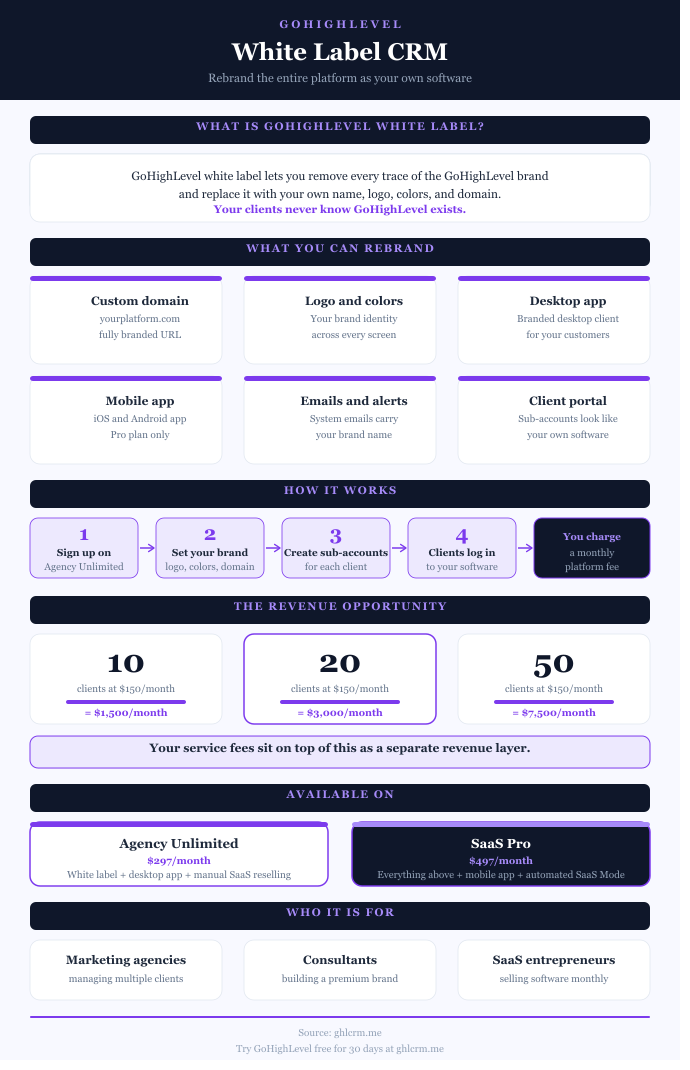
GoHighLevel white label CRM pricing infographic showing how agencies can customize the GHL platform with their brand, setup client login and pricing tiers.

Go High Level (GHL) White Label CRM: Cost, Features & Guide for Agencies

Go High Level white label CRM helps marketing agencies become software companies without coding. For $297 a month, you can rebrand the entire platform with your logo, colors, and custom domain, then sell it to clients as if you built the software yourself.

This business model generates predictable recurring revenue that scales independently of service delivery hours. In this guide, I will walk you through the core white-label features for agencies, costs, and step-by-step setup instructions.

What Is White Label in Go High Level?

GoHighLevel white label CRM pricing infographic showing how agencies can customize the GHL platform with their brand, setup client login and pricing tiers.

White labeling removes all GoHighLevel branding from the platform and replaces it with yours. When clients log in to your branded version of the software, they only see your logo, colors, and your brand throughout their experience. GoHighLevel remains completely invisible. To clients, this appears as software you built, not a rebrandable platform you lease.

This differs fundamentally from affiliate marketing or reselling. You’re not directing clients to GoHighLevel’s website or earning commissions on referrals. You control pricing, packaging, support, and the entire customer relationship.

The platform provides the technical infrastructure while you own the brand equity and client relationships.

GoHighLevel White Label Features for Agencies

GoHighLevel white label features are the tools that agencies in Canada, the US, and around the world use to deliver a fully professional, proprietary software experience to every client they onboard.

Here is a breakdown of the tools agencies get access to across both white label pricing plans (Agency Unlimited & Pro).

Custom Domain and Branded Login Page

Clients access the platform through your subdomain and land on a login page that reflects your brand.

The GoHighLevel name is nowhere in sight. Every interaction begins and ends inside your branded environment.

System-Wide Link Branding

The GoHighLevel white label features extend well beyond the login page. Every link generated by the platform, whether in an email, an SMS, a calendar booking, or a form submission, uses your custom domain.

Clients interacting with any part of the system encounter only your brand at every touchpoint.

Unlimited Client Sub-Accounts

The Agency Unlimited plan allows you to create completely isolated branded environments for each client at no additional cost per account. Each sub-account operates independently with its own contacts, pipelines, automations, and reporting while sitting under your white-labeled umbrella.

Whether you are managing five clients or fifty, the platform cost stays exactly the same.

White-Label Desktop App

The GoHighLevel white-label desktop app is available for $297/month on the Agency Unlimited plan. This tier provides unlimited sub-accounts, meaning you can create separate branded environments for each client without additional platform fees.

This reinforces the perception that your agency has built and owns the software they depend on daily, rather than reselling access to a third-party platform.

White-Label Mobile App

The GoHighLevel white-label mobile app is available exclusively on the Agency Pro plan at $497/month. It takes the branded experience to iOS and Android.

Clients download an app from the App Store or Google Play that carries your agency’s name and branding, giving them full platform access on their phones under your identity.

Rebilling Infrastructure

GoHighLevel white label SaaS includes two levels of rebilling infrastructure depending on the plan. The Agency Unlimited plan supports manual billing, allowing agencies to invoice clients directly for platform access at their own pricing and on their own schedule.

The Agency Pro plan offers SaaS Mode. This feature automates the entire billing process via Stripe integration.

Clients pay through a branded checkout page, subscriptions renew automatically, failed payments trigger dunning sequences, and branded invoices are issued without any manual input.

Clients receive invoices that bear your company name and never see any reference to GoHighLevel at any point in the billing process.

API Access

Both GHL white label plans include API access, though the depth differs between them. The Agency Unlimited plan provides basic API access for standard integrations with third-party tools and platforms.

The Agency Pro plan provides advanced API access. This gives agencies greater flexibility to build custom integrations, connect proprietary systems, and extend platform functionality.

Tiered Subscription Packaging

Available on the Agency Pro plan through SaaS Mode, tiered subscription packaging allows agencies to create multiple pricing tiers with different feature sets under their white-labeled GoHighLevel SaaS product.

For example, a basic tier might include CRM and email marketing. A professional tier adds SMS and advanced automation.

The premium tier may include AI tools and priority features. Each tier is priced independently, giving agencies the infrastructure to run a structured software business with clearly defined plans.

Snapshot Deployment

Agencies can build templates containing funnels, workflows, email sequences, SMS campaigns, and pipeline stages for specific industries.

They can then deploy them to new client sub-accounts.

What would otherwise take days of manual setup deploys in minutes. GoHighLevel white label SaaS businesses that invest in building quality snapshots upfront scale their onboarding capacity without proportionally scaling their time.

Priority Support

Priority support is available exclusively on the Agency Pro plan. It ensures that issues are escalated and resolved faster than on lower-tier plans.

For agencies managing active client campaigns at scale, where a platform issue requires rapid resolution, a faster response time is a practical operational advantage that pays for itself when something urgent needs fixing.

How to White Label GoHighLevel (GHL)

To white-label GHL, you need to rebrand the platform as your own by customizing the company settings in your dashboard to include your logo, domain, and company details. You will also set up sub-accounts that reflect your brand, client login, and pricing tiers that make sense for your business.
The following steps will guide you through the entire process.

Step 1: Sign up or Upgrade to Agency Unlimited or Agency Pro

White-label capabilities require the Agency Unlimited plan at $297/month (desktop white-label) or the Agency Pro plan at $497/month (mobile apps plus SaaS Mode).

The Starter plan at $97/month doesn’t include white-label features. Sign up or upgrade through your GoHighLevel dashboard.

Step 2: Set Up Your Custom Domain

Create a subdomain specifically for your white label platform, such as app.youragency.com or crm.yourbrand.com. Go to your DNS provider (GoDaddy, Cloudflare, Namecheap, etc.) and create a CNAME record with these settings:

  • Host/Name: Your chosen subdomain (for example, “app”)
  • Points to/Target: app.msgsndr.com
  • TTL: Leave as default unless your provider requires specific values

Step 3: Configure White Label Domain in GoHighLevel

Log in to your Agency account and navigate to Settings, then Agency Settings, then Company, and finally Whitelabel, then Whitelabel Domain. Enter your whole subdomain (for example, app.youragency.com) and click Update. GoHighLevel will automatically issue an SSL certificate once DNS propagation is complete, which typically takes 15 minutes to 2 hours.

Step 4: Upload Your Logo

In Agency View, go to Settings, then Agency Settings, then Company. Upload your agency logo with recommended dimensions of approximately 350×180 pixels, with a maximum file size of 2.5 MB. A PNG file with a transparent background works best for a professional appearance across different interface backgrounds.

Step 5: Add Legal Documentation URLs

In the same Company settings section, paste your Privacy Policy URL and Terms & Conditions URL. These links appear in the footer of your white label login page, ensuring legal compliance and building client trust.

Step 6: Configure Email Settings (Optional but Recommended)

For emails sent from your platform to display your domain, set up a transactional email provider like Mailgun or SendGrid. Navigate to Settings, then Email Services, and configure your provider. Verify your domain through SPF, DKIM, and DMARC records in your DNS settings to ensure proper email deliverability.

Step 7: Test Your White Label Login

Wait for DNS propagation to complete (check using tools like whatsmydns.net). Open your custom domain (for example, http://app.youragency.com) in a browser. You should see your branded login page with your logo and legal links displayed. SSL should automatically redirect HTTP to HTTPS once the certificate is issued.

Step 8: Set Up SaaS Mode (Agency Pro Only)

If you’re on Agency Pro, navigate to Settings, then SaaS Mode Configuration. Here you can create custom pricing tiers, define feature access per tier, and configure automated Stripe billing. This enables you to charge clients for monthly subscriptions automatically.

Step 9: Create Industry Snapshots

Build pre-configured templates containing funnels, workflows, email sequences, and SMS campaigns for your target industries. These snapshots deploy instantly to new client sub-accounts, dramatically reducing onboarding time from days to minutes.

Who Needs White Label

Growing Agencies managing 5+ clients benefit immediately. The professional white label branding positions you as an established software provider rather than a freelancer reselling someone else’s tools. Clients perceive higher value, justifying premium pricing and improving retention.

Niche Specialists serving specific industries, such as dental practices, real estate teams, fitness studios, or law firms, can create industry-specific branded solutions. “DentalFlow CRM” or “RealtyConnect Platform” commands higher prices than generic marketing software, even when the underlying infrastructure remains identical.

Service-to-SaaS Transitions work beautifully with white label capabilities. Agencies tired of trading time for money can gradually shift clients from service retainers to software subscriptions plus reduced service hours. This hybrid model maintains revenue while reducing workload.

Entrepreneurs building SaaS businesses without technical skills can launch software companies in weeks rather than years. The white-label infrastructure eliminates $50,000- $ 500,000 in development costs while providing battle-tested features customers actually use.

GoHighLevel White Label: Final Words

Go High Level white-label transforms agencies from service providers into software companies at previously impossible price points. The $297-497 monthly investment offers infrastructure that would cost $50,000-500,000 to build from scratch, if you even possessed the technical expertise to attempt it.

For agencies managing 5+ clients and serious about recurring-revenue models, white-label capabilities pay for themselves within the first month. The combination of professional branding, unlimited client accounts, and SaaS billing infrastructure creates business model opportunities that didn’t exist a decade ago.

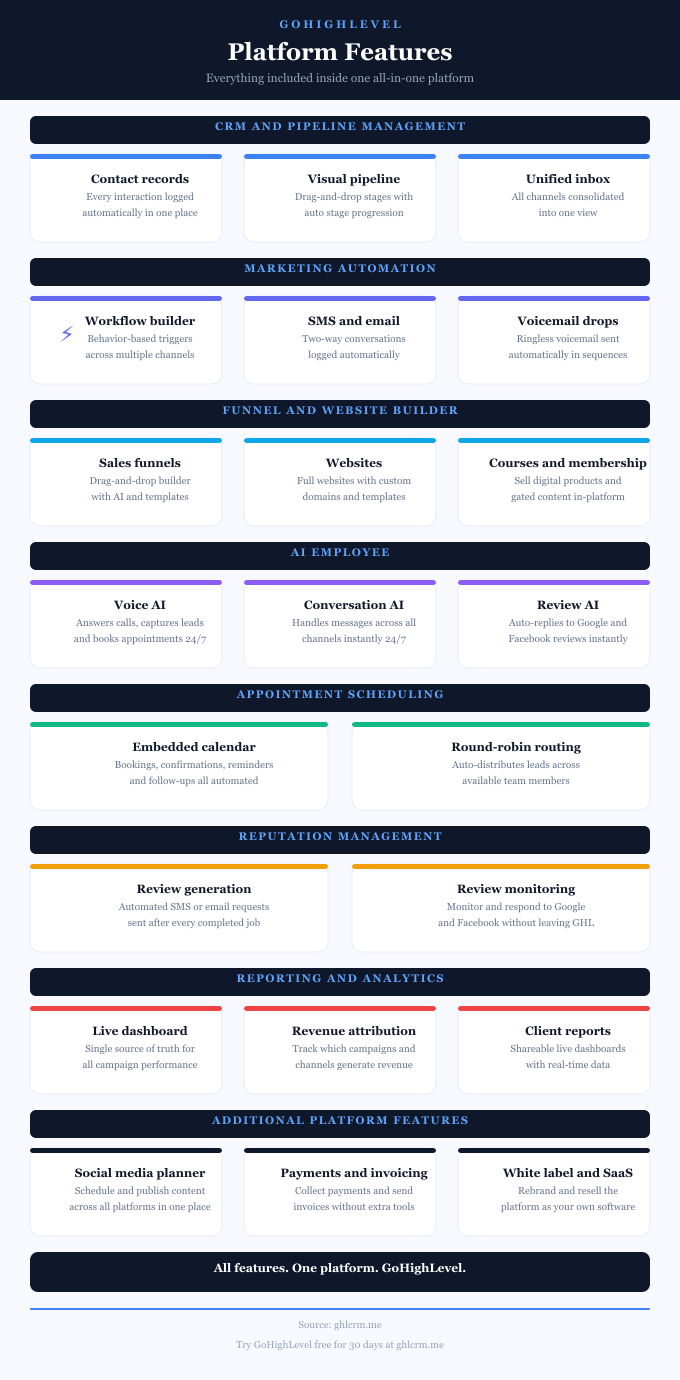
GoHighLevel features infographic showing the all-in-one platform's list of tools, and the value they provide for agencies, and local businesses.

13 Top GoHighLevel Features to Transform Your Marketing

GoHighLevel features transform how agencies and businesses manage customer relationships by consolidating 10-15 separate tools into a single unified platform.

From advanced pipeline management and multi-channel communication to AI-powered automation and white-label capabilities, the system delivers enterprise functionality at a fraction of the cost of traditional solutions.

Let’s explore the features that make this platform the #1 marketing automation software powering over 529,000 websites worldwide.

Top GoHighLevel (GHL) Features

GoHighLevel features infographic showing the all-in-one platform's list of tools, and the value they provide for agencies, and local businesses.

1. Complete Contact Management System

This GHL feature is a robust contact database that tracks every customer interaction across all communication channels, creating comprehensive behavioral profiles rather than just basic contact storage.

360-Degree Contact Records provide complete visibility into each lead’s journey. When someone enters your system, whether through a Facebook ad, website form, or referral, the CRM captures their source, tracks every email opened, SMS received, page visited, and call made.

This eliminates the frustration of asking “which list are they on?” or “did we already send them this?” You have one definitive source of truth.

Unlimited Contacts on All Plans removes growth anxiety. Unlike HubSpot, Salesforce, or ActiveCampaign, which charge based on contact count, Go High Level includes unlimited contacts even on the $97/month Starter plan.

Your database can grow from 1,000 to 100,000 contacts without affecting your monthly bill.

Smart Lists change how you segment contacts by automating the whole thing. These dynamic lists update themselves in real time based on tags, custom fields, how people engage with you, or where they are in your sales pipeline.

You can create lists like “opened an email in the last 30 days but never booked an appointment” or “bought something in the last 90 days and tagged as VIP.” No manual updating required.

Smart Lists can kick off workflows automatically, so you can deliver personalized engagement at scale without lifting a finger.

Custom Fields let you track whatever data matters to your business. Real estate agents can capture property budgets. Medical practices can save treatment preferences. Gyms can track what equipment people use. These fields work throughout the whole platform.

Use them to personalize emails, trigger workflows, organize your pipeline stages, and pull reports.

Bulk Actions speed up contact management like crazy. Update tags for hundreds of people at once. Change opportunity stages for entire groups.

Move whole segments through your pipeline with a single click, instead of updating each record individually.

2. Pipeline Management and Sales Tracking

Go High Level includes fully customizable sales pipelines that visualize lead progression through each stage of your sales process, providing clarity that spreadsheets and basic CRMs cannot match.

Visual Pipeline Builder lets you create unlimited pipelines customized to different business processes. A marketing agency might maintain separate pipelines for website design projects, SEO retainers, and paid advertising campaigns.

Each pipeline contains custom stages reflecting your actual workflow, from initial inquiry through proposal, contract, onboarding, and fulfillment.

Drag-and-Drop Functionality makes pipeline management intuitive. Move opportunities between stages by dragging cards across the board.

This visual approach instantly reveals bottlenecks. If 40 deals sit in the “Proposal Sent” stage, you know follow-up needs improvement.

Opportunity Tracking captures deal value, close probability, and expected close dates. The dashboard displays total pipeline value, weighted forecast based on probability percentages, and monthly revenue projections.

This forecasting capability helps agencies predict cash flow and make informed hiring decisions.

Automated Stage Actions trigger workflows when opportunities move between stages. When a deal moves to “Contract Signed,” automatically send onboarding emails, create project tasks, schedule kickoff calls, and notify team members.

Pipeline Analytics reveal conversion rates between stages, average time in each stage, and win/loss reasons. These insights identify where leads drop off, which sources convert best, and which sales tactics work.

3. Multi-Channel Communication Hub

Go High Level CRM’s communication capabilities extend far beyond basic email, providing true omnichannel engagement that meets customers wherever they prefer to interact.

Unified Inbox integrates messages from email, SMS, Facebook Messenger, Instagram DMs, WhatsApp, Google Business Messages, and website chat into one interface.

No more toggling between Gmail, Facebook, and SMS apps; all conversations appear in a single, organized dashboard with full context about each contact.

Two-Way SMS Conversations enable genuine text-based dialogue, not just broadcast messaging. The platform supports text conversations with appointment booking, payment collection, and multimedia messaging.

For local service businesses where 73% of customers prefer text communication, this proves invaluable for confirmations, reminders, and customer service.

Built-In Phone System (LC Phone) eliminates the need for separate telephony providers. Features include call recording for quality control, call tracking with source attribution, voicemail drops for efficient follow-up, IVR (Interactive Voice Response) for intelligent call routing, and click-to-call functionality directly from contact records.

This replaces CallRail, RingCentral, or similar services at $50-200/month.

Email Marketing includes a professional email builder with drag-and-drop editing, pre-built templates, A/B testing, advanced personalization with custom fields, and detailed deliverability tracking.

The system supports unlimited email sending on all plans, with usage-based pricing around $0.675 per 1,000 emails sent.

Missed Call Text Back automatically sends SMS messages when calls go unanswered, preventing lead loss during off-hours or high-volume periods. This feature ensures instant engagement even when you’re unavailable.

4. Workflow Automation and Campaign Builder

The visual workflow builder represents Go High Level CRM’s automation backbone, enabling sophisticated multi-channel campaigns that run on autopilot.

Drag-and-Drop Workflow Designer provides an intuitive interface for building complex sequences by dragging triggers and actions onto a canvas. Triggers include form submissions, appointment bookings, tag applications, opportunity stage changes, email opens, link clicks, and dozens more behavioral signals.

Multi-Channel Actions within single workflows coordinate email, SMS, voicemail drops, Facebook messages, task assignments, and webhook calls.

A lead nurture sequence might send an initial email, wait 2 days, send an SMS if the email wasn’t opened, wait 3 more days, then send a voicemail drop all automatically based on engagement.

Conditional Logic creates branching paths based on contact attributes or behaviors. If a contact opens an email and clicks a specific link, send them down one path. If they don’t open within 3 days, send them another. This dynamic routing personalizes experiences at scale.

AI-Powered Workflows now include GPT-4 integration for intelligent automation. Workflow AI can analyze message sentiment, generate personalized responses, score lead quality, summarize conversations, and make dynamic decisions without manual rules.

This transforms static if-then automation into intelligent, adaptive systems.

Template Library provides pre-built workflows for common scenarios, such as appointment reminders, abandoned cart recovery, welcome sequences, review requests, and re-engagement campaigns. Import templates and customize them rather than building from scratch.

5. Website and Funnel Builder

Go High Level includes comprehensive website and funnel creation tools, eliminating the need for WordPress, ClickFunnels, or Leadpages.

Drag-and-Drop Page Builder lets you create professional websites, landing pages, and sales funnels without coding. The interface provides intuitive controls for adding text, images, videos, forms, countdown timers, testimonials, and custom HTML elements.

Mobile-Responsive Templates ensure pages display perfectly across devices. The template library includes hundreds of designs for various industries and purposes, including lead-generation pages, webinar-registration funnels, product-sales pages, appointment-booking pages, and complete websites.

A/B Testing enables split testing between variations to optimize conversion rates. Test headlines, images, calls-to-action, or entire page layouts. The system tracks performance metrics and identifies statistical winners.

Custom Domains allow you to host pages on your own branded domains. Connect multiple domains for different campaigns or clients, all managed within the platform.

SEO Optimization Tools include editing meta titles and descriptions, image alt text, URL customization, structured data markup, and sitemap generation. Pages load quickly and follow SEO best practices out of the box.

Form and Survey Builder captures lead information through embedded forms or pop-ups. Forms integrate directly with the CRM, automatically creating contacts, applying tags, and triggering workflows based on submissions.

6. Appointment Scheduling and Calendar Management

The integrated calendar system in GoHighLevel eliminates the need for Calendly, Acuity Scheduling, or similar third-party tools while providing superior functionality.

Customizable Booking Pages let prospects schedule appointments directly through branded pages. Configure available times, buffer periods between appointments, appointment types (15-minute consultation, 60-minute strategy session), and booking rules.

Team Calendar supports round-robin assignment, distributing appointments evenly across team members. This proves essential for sales teams, support departments, or agencies with multiple service providers.

Automated Reminders reduce no-shows through SMS and email confirmations sent automatically at booking, plus reminder messages at 24 hours, 1 hour, or custom intervals before appointments.

Payment Collection at booking enables deposits or full payment to be collected before appointments. Integrate Stripe to charge consultation fees, secure event tickets, or collect retainers, reducing no-shows while capturing revenue upfront.

Google and Outlook Calendar Sync prevent double-booking by checking external calendars. When appointments are booked in GoHighLevel, they automatically appear in connected calendars.

Group Appointments accommodate workshops, webinars, or classes with multiple attendees. Set maximum capacity, track registrations, and manage waitlists seamlessly.

7. Reputation Management and Reviews

Online reviews directly impact customer decisions and local search rankings. Go High Level CRM automates reputation management that typically requires dedicated tools at $50-150/month.

Automated Review Requests send review solicitation messages via SMS or email after completed appointments or purchases. Timing automation ensures requests arrive when customer satisfaction peaks.

Multi-Platform Monitoring tracks reviews from Google My Business and Facebook and combines them into a central dashboard. See all feedback in one place without checking multiple platforms.

Reviews AI automatically responds to reviews based on sentiment analysis. Positive reviews receive thank-you messages, neutral reviews get engagement responses, and negative reviews trigger appropriate damage control, all customized to maintain brand voice. This AI capability is available for $97/month (unlimited) or approximately $0.08 per review on a pay-per-use basis.

Review Funnel directs happy customers to public review platforms while routing dissatisfied customers to private feedback forms. This strategy increases positive public reviews while addressing negative feedback privately.

8. Social Media Management

The Social Media Planner in GoHighLevel centralizes social marketing, eliminating the need for Buffer, Hootsuite, or Later at $20-80/month per platform.

Multi-Platform Scheduling publishes content to Facebook, Instagram, Google My Business, LinkedIn, and TikTok from one interface. Schedule posts days or weeks in advance to maintain a consistent social presence without daily manual posting.

Content Calendar View displays scheduled posts across all platforms in a unified calendar format, revealing gaps, clustering, and strategic timing at a glance.

Bulk Upload enables agencies managing multiple clients to upload months of content at once via CSV files, dramatically accelerating content scheduling.

Post Templates save commonly used post formats, hashtag sets, or messaging frameworks for quick reuse across similar posts or clients.

Comment Management allows users to view and respond to comments directly within the platform (introduced in 2025), eliminating the need to switch between social media accounts for engagement.

9. Membership Sites and Course Platform

Go High Level CRM includes a complete learning management system (LMS), replacing Teachable, Kajabi, or Thinkific at $99-199/month.

Unlimited Courses can be created for your business or clients, each with unlimited lessons, modules, and video hosting, with no per-student or storage limits.

Drip Content Scheduling releases lessons on predetermined schedules to maintain engagement while preventing overwhelm. Set lessons to unlock based on signup date, previous lesson completion, or specific dates.

Quizzes and Assessments test comprehension and provide completion certificates. Track student progress, identify struggling learners, and gather feedback through integrated surveys.

Community Features enable discussion forums, member directories, and peer interaction within course platforms, building engaged communities around your content.

Flexible Pricing supports free courses, one-time purchases, subscription models, payment plans, and bundle pricing, all processed through integrated Stripe payments.

10. AI Employee Suite

The AI Employee suite represents Go High Level’s most significant advancement, providing six AI-powered tools that function as virtual team members.

Conversation AI

GoHighLevel conversation AI powers 24/7 chatbots across SMS, Facebook Messenger, Instagram DMs, WhatsApp, and website chat. The AI learns from your business information, FAQs, and past conversations to provide contextually appropriate responses.

It qualifies leads, answers common questions, schedules appointments, and escalates complex issues to humans, all while maintaining your brand voice.

Voice AI

GHL voice AI acts as a virtual receptionist, answering calls when you’re unavailable. Using natural language processing, it conducts human-like conversations, qualifies leads by asking predetermined questions, schedules appointments by checking calendar availability, updates CRM records in real-time, and provides information about services or products.

Reviews AI

HighLevel reviews AI monitors and automatically responds to Google and Facebook reviews. The sentiment analysis determines whether reviews are positive, neutral, or negative, and then generates appropriate responses that match your brand tone.

This ensures no review goes unanswered while maintaining consistent reputation management.

Content AI

The content AI tool generates marketing copy, social media posts, blog articles, email campaigns, and product descriptions. It also creates custom-branded images for social media, advertisements, and website content, eliminating the need for separate design tools.

Funnel AI

GHL AI funnel builder creates complete sales funnels from text descriptions. Describe your desired funnel (“three-page funnel for a dentist with before-and-after gallery and appointment booking”), and Funnel AI generates the structure, sections, and placeholder content.

It can also import designs from URLs or screenshots, replicating successful funnels from competitors or other sources of inspiration.

Workflow AI

The High Level workflow AI assists in building automation sequences by suggesting triggers, actions, and logic based on described goals. I use it to troubleshoot existing workflows and identify errors.

The AI Employee suite is available for $97/month with unlimited usage, or on a pay-per-use basis, making enterprise-level AI accessible to small businesses and agencies.

11. Reporting and Analytics

Go High Level CRM provides customizable dashboards and detailed reporting across all platform features.

Customizable Dashboards display KPIs most relevant to your business, including leads generated, revenue by source, appointment booking rates, email open rates, SMS delivery rates, pipeline conversion rates, and more. Create different dashboards for different roles (sales team, marketing team, executives).

Attribution Tracking reveals which marketing sources generate revenue, not just leads. Track customer journeys from initial touchpoint through purchase, calculating ROI for Facebook ads, Google ads, SEO, referrals, or any other channel.

Funnel Analytics shows conversion rates at each funnel step, identifying where prospects drop off.

Email and SMS Analytics track open rates, click rates, reply rates, unsubscribe rates, and conversion rates, providing insights to optimize messages.

Call Analytics (with LC Phone) captures call duration, call outcomes, recording playback, and call source attribution, which is valuable for businesses where phone communication drives revenue.

12. Integration Ecosystem

While GoHighLevel aims to be all-in-one, it recognizes that businesses sometimes use specialized tools. The platform offers 800+ native integrations plus Zapier support.

Payment Processors: Stripe, PayPal, Authorize.net, NMI, Square

Email Services: Gmail, Outlook, Mailgun, SendGrid

Calendars: Google Calendar, Outlook Calendar, iCloud

Social Media: Facebook, Instagram, LinkedIn, TikTok

Webinar Platforms: Zoom, WebinarJam, EverWebinar

E-commerce: Shopify, WooCommerce

Analytics: Google Analytics, Facebook Pixel, Google Tag Manager

API Access (available on Unlimited and SaaS Pro plans) enables custom integrations with proprietary systems or specialized software not in the integration library.

13. White-Label and Agency Features

Go High Level CRM’s white-label SaaS feature distinguishes it from competitors, transforming agencies from service providers into software companies.

Custom Branding on Unlimited ($297/month) and SaaS Pro ($497/month) plans replaces all GoHighLevel branding with your logos, colors, and domains. Clients log into “your” platform at app.youragency.com, seeing only your brand throughout their experience.

White-Label Mobile App (SaaS Pro plan) enables publishing iOS and Android apps under your brand in Apple App Store and Google Play Store. Clients download “your” app rather than GoHighLevel’s, significantly increasing perceived value.

Unlimited Sub-Accounts on the Unlimited and SaaS Pro plans let agencies create separate, branded accounts for each client, all managed from a master agency dashboard. Each client receives isolated data, customized features, and individual billing.

SaaS Mode (SaaS Pro plan) enables you to resell the platform as your own software. Define custom pricing plans, package features per tier, automate client billing through Stripe, and create recurring revenue streams independent of service delivery.

GoHighLevel Features: Enterprise Power, Small Business Price

Go High Level features deliver comprehensive business management typically requiring $500-1,500/month in separate subscriptions for just $97-497/month, a cost structure that fundamentally changes small business and agency economics.

The platform’s strength lies not in individual features (many competitors offer email marketing or funnel builders) but in its depth of integration. Every feature connects to the unified contact record, creating seamless workflows impossible with disconnected tool stacks.

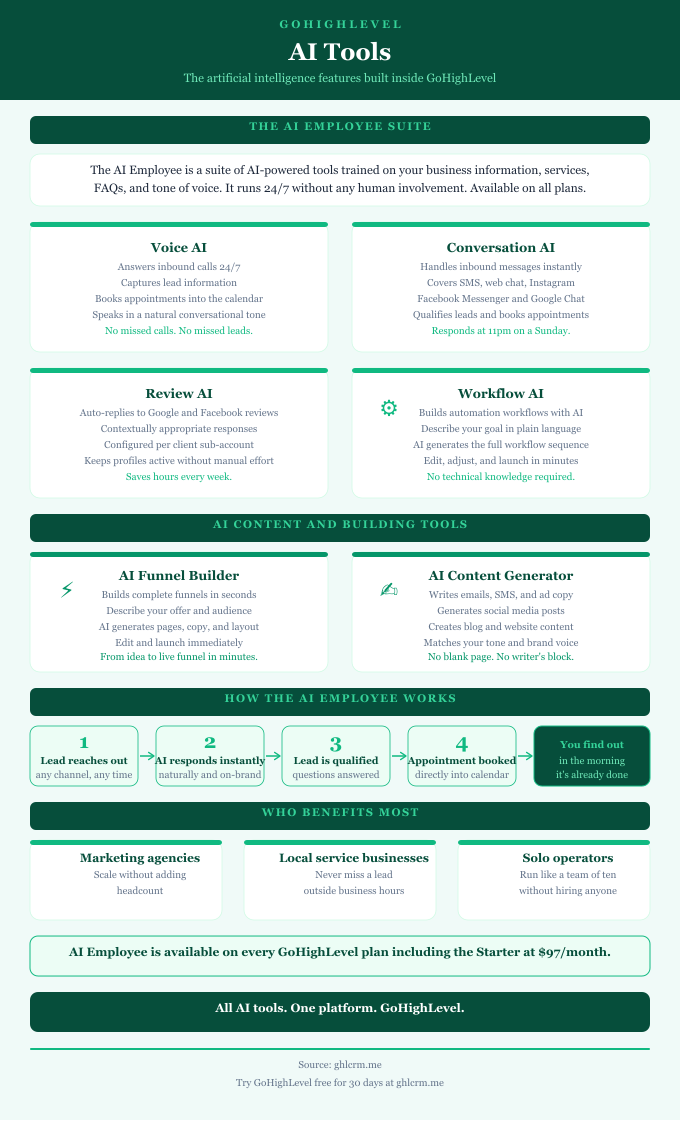
GoHighLevel AI tools infographics detailing the benefits of each features and how the AI employee works around the clock to help generate leads, and close deals.

GoHighLevel AI Tools: 6 Transformative AI Automation Features

GoHighLevel has introduced six powerful AI tools, collectively known as AI Employee, designed to handle everything from customer conversations to sales-funnel creation.

These tools integrate seamlessly with the platform’s existing CRM and automation infrastructure, eliminating the need for multiple subscriptions and the complexity of integrations that plague traditional marketing stacks.

The GoHighLevel AI tools include Reviews AI, Conversation AI, Voice AI, Workflow AI, Funnel AI, and Content AI.

6 Go High Level (GHL) AI Tools

GoHighLevel AI tools infographics detailing the benefits of each features and how the AI employee works around the clock to help generate leads, and close deals.

1. Reviews AI: Automated Reputation Management

Online reviews are now the digital equivalent of word-of-mouth recommendations, directly influencing consumer decisions and local search rankings. Reviews AI helps businesses respond to reviews, manage feedback, and protect reputation with smart, automated replies.

How Reviews AI Works

GoHighLevel’s Reviews AI operates in two distinct modes to accommodate different business needs and comfort levels with automation:

Suggestive Mode provides AI-generated response suggestions that users can review, edit, and approve before publishing. It gives recommendations based on the review content, making it easier to engage with your customers authentically. This mode offers businesses complete control while accelerating the response creation process.

Auto-Pilot Mode takes automation further by responding automatically to reviews based on predetermined criteria. Users can customize automated responses based on star ratings, set the wait time before sending each response, and add a personal touch with review-response footers. This ensures consistent engagement even during off-hours or periods of high volume.

Extra Features

This includes GoHighLevel AI Agents, which are customizable AI personalities you can set up based on the type of review. You can create different personalities that automatically respond to reviews with the right tone, sentiment, and style.

You can set up different agents for positive, neutral, and negative reviews. That way, each type of review gets the right kind of response.

The system supports multiple languages and monitors both Google and Facebook reviews as they come in. The second a review pops up, it’s pulled into your dashboard, and the AI instantly determines whether it’s positive, neutral, or negative.

Why This Matters for Your Business

How fast you respond to reviews actually matters for your Google ranking. Google likes businesses that consistently engage with reviewers, which can help you show up higher in local searches. Reviews AI makes sure every review gets answered, which builds trust with customers while keeping your brand voice consistent.

The pricing is pretty reasonable, too. After your free trial, you’re paying about a penny per review response. Even small businesses can afford professional reputation management at that rate.

2. Conversation AI: Around-the-Clock Multi-Channel Customer Support

These days, customers expect instant responses no matter how they reach out. That’s tough for businesses without dedicated support teams. Conversation AI handles this by giving smart, context-aware responses across text, Facebook, Instagram, and live chat.

What It Does

GoHighLevel Conversation AI lets your business provide real-time 24/7 support across all your channels, with unlimited conversations. You don’t need an OpenAI API key either, which saves you extra costs and headaches managing another account.

The system learns about your business, your products, and how you usually talk to customers. Then it gives relevant, personalized responses. You train it by feeding it your knowledge base, FAQs, and specific ways to handle common questions.

How Businesses Actually Use It

Customer Support: The AI handles boring routine stuff like business hours, pricing, what services you offer, and your policies. Your real staff can focus on complicated issues that need a human touch.

Lead Qualification: Conversation AI helps confirm times with clients, book appointments on your calendar, and handle those first sales questions based on what customers seem interested in.

Booking Appointments: The AI walks prospects through scheduling in a natural way. It checks your availability and confirms bookings without anyone on your team lifting a finger.

Making It Sound Like You

You can customize it to sound like your brand. Set whether it should be professional or friendly. Adjust how long responses should be. Tell it when to pass things to a real person. You can even set working hours so it only talks to people during certain times if you want.

3. Voice AI: Smart Phone Call Handling

Missing phone calls means missing money, especially if you’re in healthcare, real estate, or professional services where people book appointments. GoHighLevel Voice AI works like a receptionist who never sleeps, ensuring every call is handled professionally.

How Voice AI Works

GHL Voice AI makes sure you don’t lose leads by being your virtual receptionist 24/7. It has efficient, human-like conversations that keep customers happy while gathering important information.

The system handles incoming and outgoing calls using natural language processing. Basically, it talks like a real person. People calling in feel understood and valued because the conversation feels natural.

Main Features

Lead Qualification: Voice AI screens calls, asks questions to figure out if they’re serious leads, then either routes them to the right team member or schedules a callback.

Booking Appointments: It checks your calendar, suggests times that work, and confirms bookings just by talking. Makes the whole booking process smooth.

Sales Help: For basic questions about what you offer, how much it costs, or what services you have, Voice AI gives accurate info right away. It keeps leads warm even when your sales team isn’t around.

How It Works with Everything Else

Voice Agents connect with your CRM and automation workflows. Every call gets logged and transcribed, and it can automatically trigger follow-up sequences. This gives you a complete picture of the customer journey while setting up sophisticated campaigns based on what happened on the call.

The analytics let you track how successful calls are, how accurate responses are, how long calls take, and how satisfied customers are. All that data helps you keep improving.

4. Workflow AI: Making Automation Easy

Building good automation workflows usually requires technical expertise and a lot of time. Workflow AI makes it easier by guiding you, suggesting, and adding AI-powered actions that make complicated tasks accessible even if you’re not technical.

How Workflow AI Helps

Workflow AI Assistant walks you through building automations. It helps you troubleshoot, build, and optimize workflows that fit your business goals. You describe what you want in plain English, and the AI suggests the right triggers, conditions, and actions to make it happen.

It gives you real-time suggestions as you build, spots potential mistakes, recommends ways to improve, and ensures you’re following best practices. This cuts down the learning curve big time.

AI Actions Inside Your Workflows

Beyond just helping you build, Workflow AI lets you add sophisticated AI actions right into your automations. You can add AI decision points that look at data, create personalized content, or figure out what to do next based on how customers behave.

For example, a workflow might use AI to review what a customer has bought before and how they’ve interacted with you, then create a personalized email offer tailored to what that person likes and how likely they are to buy.

Using It for Lead Nurturing

Workflow AI uses ChatGPT-4 to create and send messages to leads. It builds personalized follow-up sequences that change based on how people engage. The AI can format data, walk new customers through onboarding with custom instructions, and answer questions throughout automated sequences.

This turns boring static workflow templates into dynamic, responsive systems that adjust to each customer while still running automatically.

5. Funnel AI: Build Sales Funnels Fast

Creating sales funnels that actually convert usually needs design skills, copywriting chops, and a lot of time. Funnel AI speeds this up dramatically. You can generate complete funnel pages in minutes instead of days.

What It Does

With GoHighLevel Funnel AI, you can create great-looking pages in minutes with optimized layouts and content. The system asks you conversational questions about your business, who you’re targeting, and what your campaign is trying to do. Then it generates designs that fit.

You type what you want, and the AI builds the structure, sections, and fills in content to match what you described. For example, ask for a “three-page funnel for an orthodontist with before-and-after photos and a consultation form,” and it produces exactly that.

Copying Designs You Like

Beyond building from scratch, Funnel AI has a cool import feature. Paste in a public URL or upload a screenshot of a design you like. The AI extracts the visual theme and layout and creates a new page in HighLevel that matches that design.

This lets you replicate successful designs from competitors or anywhere you find inspiration while still keeping it original and customizable.

Built-In SEO

The builder automatically fills in meta titles, descriptions, and image alt text with keywords. Every page launches with a solid SEO foundation, so you don’t have to do SEO work after you build it.

6. Content AI: Faster Content Creation

Content creation eats up time like nothing else. You need creativity, strategy, and consistent execution. GoHighLevel Content AI addresses this by generating high-quality written content and images across various marketing channels.

What It Can Generate

Content AI makes blog articles, social media posts, email copy, product descriptions, website text, and ad copy.

You put in keywords, pick the tone (professional to funny), and say how long you want it. The AI generates content that fits your brand, and you can use it right away or tweak it more.

Making Images Too

Content AI doesn’t just do text. It creates images too. This tool is built into funnels, websites, email builders, and your media library.

You can create custom visuals without leaving the platform or paying for separate tools like Midjourney or DALL-E. Makes your creative workflow way smoother.

Where You Can Use It

Content AI is built into GoHighLevel across the platform. You’ll see it in the social planner, blog builder, email composer, and funnel editor. You can generate content right when you need it, which reduces friction.

How Much Time It Saves

Content AI creates content and saves you time on planning, writing, and editing. For agencies managing content for multiple clients, this time savings really adds up. You might cut content production time by 60 to 70%.

You can keep different brand voices for different campaigns while using AI to speed things up. Set tone parameters that match your brand guidelines while changing the style for different audiences.

GoHighLevel AI Pricing and How to Get It

GoHighLevel has flexible pricing for its AI Employee suite that works for businesses at different stages.

Unlimited Plan

If you’re ready to go all-in on AI, the unlimited plan gives you unlimited access to all AI features for $97 per location per month. That includes unlimited Voice AI, Conversation AI, Reviews AI, Content AI, Funnel AI, and Workflow AI.

This flat pricing works great if you use a lot of AI and don’t want to worry about usage charges. Note that SMS and voice call minutes are still billed separately by your phone provider.

Pay-Per-Use Model

If you’d rather pay for what you use or just test specific features, GoHighLevel lets you pay only for what you consume. Works well for smaller businesses or if you’re slowly adding AI capabilities.

Why Agencies Love It

Agencies using GoHighLevel can resell AI Employee access to clients and mark it up to make extra money. The white-label features let you brand the AI tools as your own, which adds value to what you’re selling.

How to Actually Use This Stuff

Getting GoHighLevel’s AI tools working well takes some planning. You can’t just turn everything on and hope for the best.

Start Where It’ll Help Most

Figure out what’s eating up the most time in your business or where slow responses are costing you money. For businesses that book appointments, Voice AI and Conversation AI usually pay off right away.

Train It and Make It Yours

All the AI tools work better when you train and customize them. Spend time building a solid knowledge base, setting the right tone, and creating escalation rules. Better training and instructions mean better AI output.

Keep an Eye on It and Make Improvements

Use the analytics dashboards to see how the AI is performing across all the tools. Look at conversation logs, funnel conversion rates, and how people engage with your content. Keep refining your prompts, adjusting settings, and updating training data based on what you see.

Use the Tools Together

The real magic happens when you combine tools. Conversation AI qualifies a lead, Workflow AI triggers a personalized follow-up sequence, Content AI writes a custom email, and Voice AI makes a follow-up call. All automatically based on how someone first reached out.

GoHighLevel AI: Final Words

GoHighLevel’s AI tools take a complete approach to marketing automation. They solve real business problems with practical solutions anyone can use. These tools don’t replace human creativity and strategy. They amplify what you can already do, letting you operate at a scale that used to require way bigger teams.

The unified platform means you’re not juggling multiple AI subscriptions. The pricing is clear and predictable. For agencies, you can resell this stuff and create new revenue streams. For businesses, the time you save and efficiency you gain make it worth the investment pretty quickly.

GoHighLevel Pros and Cons from An Experienced User

The pros and cons of GoHighLevel are worth understanding clearly before you commit your business to a platform that will touch almost every part of how you operate.

This breakdown comes from five years of daily use working across agencies, local businesses, and service professionals. One where the genuine strengths are obvious, and the real frustrations are equally hard to ignore.

Here is what GoHighLevel actually gets right and where it genuinely falls short.

GoHighLevel Pros and Cons at a Glance

ProsCons
Replaces multiple tools with one platformSteep learning curve for new users
Deep marketing automation capabilitiesCustomer support can be inconsistent
White-label SaaS revenue model for agenciesAI features carry additional usage costs
AI Employee handles 24/7 communicationsCan be overkill for very small operations
Automated review generation on autopilot
Flat pricing that scales with agency growth
Consolidated reporting and dashboards
Purpose-built CRM for active lead management
Unified multi-channel inbox
Built-in course and membership platform
Scheduling connected to the entire platform
Constantly evolving with new features

Pros of GoHighLevel

1. It Genuinely Replaces Multiple Tools

The most immediate and tangible benefit of GoHighLevel is what it makes unnecessary. A typical agency or local business that runs its marketing properly might be paying for a CRM, an email marketing platform, an SMS tool, a funnel builder, a scheduling app, and a review management tool.

That stack costs anywhere between $500 and $1,000 per month before accounting for the time spent managing integrations between platforms that were never designed to talk to each other.

GoHighLevel replaces it all under one roof. More importantly, because everything is native to the same platform, the data flows cleanly between tools without workarounds or sync delays. A lead captured in a funnel shows up in the CRM instantly, triggers an automation, and lands in a pipeline stage, all without a single manual action.

That kind of seamless connectivity is genuinely difficult to replicate with a patchwork stack of separate tools.

2. The Automation Capabilities Are Seriously Deep

GoHighLevel’s workflow builder is one of the most capable automation engines available at this price point.

You can build multi-step sequences that respond to specific contact behaviors and trigger actions across email, SMS, voicemail drops, and social messaging simultaneously; set conditional logic that routes contacts differently based on what they do or do not do; and run entirely different automation tracks for different client sub-accounts on the same platform.

For agencies and service businesses that have previously used tools like ActiveCampaign or Keap, the automation depth in GoHighLevel is comparable and, in some respects, more flexible, given the breadth of channels it covers natively.

3. The White-Label and SaaS Model Is a Genuine Business Opportunity

This is the advantage of GoHighLevel that tends to change how agency owners think about their entire business model. The ability to rebrand the platform as your own proprietary software, present it to clients under your own domain and logo, and charge a monthly subscription for access is not a cosmetic feature. It is a fully functional revenue model.

Agencies that have built out this SaaS layer on top of their service business report generating significant recurring revenue from platform fees alone.

The infrastructure GoHighLevel provides to run this model, including automated client onboarding, Stripe billing integration, and tiered feature packaging, is the kind of thing that would cost a development team months to build independently.

4. The AI Employee Changes What Is Possible for Small Teams

The AI Employee suite, which includes Voice AI for inbound calls, Conversation AI for multi-channel messaging, and automated review responses, represents a meaningful shift in what a small agency or one-person service business can realistically handle.

A solo consultant or a two-person local business can now respond to inbound leads at 11pm on a Sunday, answer common questions intelligently, and book appointments into a live calendar without a human involved.

That capability used to require either a large team or an expensive custom-built solution. GoHighLevel packages it into a platform that costs less per month.

5. Reputation Management Runs on Autopilot

For local service businesses, online reviews are among the most powerful yet neglected growth levers available. GoHighLevel automates the entire review generation process. It sends timely review requests via SMS or email.

After every completed appointment or transaction, directing satisfied customers to Google or Facebook, and tracking responses directly within the platform.

The compounding effect of a consistent, automated review-generation system over 12 to 24 months can dramatically improve a local business’s search visibility and inbound lead volume without additional advertising spend. That is a pro that is easy to understate in a GHL feature list but difficult to overstate in practice.

6. Flat Pricing That Favors Growth

The Agency Unlimited plan charges a flat monthly fee regardless of how many client sub-accounts are created. An agency managing five clients and an agency managing fifty clients pay the same $297. That pricing model is unusual at this capability level and becomes increasingly valuable as a client roster grows.

Most comparable platforms charge per seat, per contact, or per account. The GoHighLevel pricing model removes the anxiety of a rising platform bill as the business scales and makes the per-client unit economics of running an agency considerably cleaner.

7. Everything Is Trackable in One Place

Campaigns, funnels, automations, calls, and conversations all run through the same platform. Agencies find it easy to share live dashboards with clients.

Local business owners can check performance at any time without logging into multiple platforms.

Revenue attribution, pipeline movement, funnel conversion rates, and appointment show rates are all visible in one place.

That consolidated visibility changes how quickly problems get spotted and how confidently decisions get made.

8. The Built-In CRM Is Purpose-Built for Lead Management

Most standalone CRM tools are designed to store contact data and not much else. GoHighLevel’s CRM was built around the assumption that leads need to be actively managed, not just recorded.

Every contact record captures the complete history of that person’s interaction with your business.

Every email opened, link clicked, form submitted, call made, and appointment booked is logged automatically. The visual pipeline gives an instant overview of where every deal stands and what action is needed next.

For local businesses juggling inbound inquiries across multiple channels and agencies managing lead-generation campaigns across multiple clients, that level of visibility into every active relationship is something most CRM tools charge significantly more to provide.

9. Multi-Channel Communication From One Inbox

GoHighLevel consolidates conversations from SMS, email, Facebook Messenger, Instagram, Google Business Messages, and web chat into a single unified inbox.

Instead of checking four different platforms to see if a lead has responded, everything lands in one place.

For a busy service professional managing their own communications, or for an agency team handling client inboxes, the reduction in context-switching alone saves a meaningful amount of time every day. It also means no lead response gets missed because it arrived through a channel that nobody checked that afternoon.

10. Built-In Course and Membership Platform

GoHighLevel includes a native membership and course platform that allows course creators to create and sell online courses, host gated content, and build client portals directly within the platform.

For coaches, consultants, and agencies that want to productize their knowledge without paying separately for tools like Teachable, Kajabi, or Thinkific, this feature removes another line from the monthly subscription list.

The content is hosted within the same ecosystem as the CRM and automation tools, meaning member activity can trigger follow-up sequences, upsell workflows, and engagement campaigns without any external integration.

11. Appointment Scheduling That Connects to Everything

GoHighLevel’s calendar and scheduling feature goes considerably further than a standalone booking tool. A booked appointment does not just create a calendar event. It triggers a confirmation workflow, updates the contact’s pipeline stage, pauses any cold outreach sequences, sends automated reminders before the appointment, and fires a follow-up sequence or review request afterward.

For a dental practice, a law firm, a personal trainer, or a home services contractor, that connected scheduling experience means no-shows drop, follow-through improves, and the post-appointment process happens consistently without anyone on the team managing it manually.

12. Constantly Evolving With New Features

GoHighLevel has a product development pace that most platforms at this price point cannot match. New features ship regularly, the AI toolset continues to expand, and the platform consistently adds integrations and capabilities in response to user feedback.

Cons (Disadvantages) of GoHighLevel

1. The Learning Curve Is Real and Steep

GoHighLevel is not a platform you can set up meaningfully in an afternoon. The depth that makes it powerful also makes it complex to navigate, particularly for users who are new to marketing automation software or CRM systems.

New users frequently report spending their entire 14-day trial period trying to understand the platform rather than actually using it to run campaigns. Without a structured onboarding process or a reliable external resource to learn from, the early experience can be frustrating enough to put people off a platform that would genuinely serve them well once they understand it.

Pairing the platform with structured learning resources from the start makes the onboarding experience significantly more productive and shortens the time it takes to see real results.

2. Customer Support Can Be Inconsistent

Support quality varies. Some tickets get resolved quickly with helpful, knowledgeable responses. Others involve longer wait times or generic replies that do not address the actual issue. The GoHighLevel community on Facebook is often more immediately useful than the official support channel for specific technical questions.

3. AI Features Carry Additional Usage Costs

The AI Employee suite operates on usage-based pricing on top of the base monthly plan. Depending on the volume of calls and messages being handled, these costs can add up.

For agencies packaging AI features into client offerings, the additional cost needs to be carefully factored into client pricing. Understanding the AI pricing structure before building it into a client package protects margins and avoids billing surprises at the end of the month.

4. Can Feel Like Overkill for Very Small Operations

GoHighLevel is built for scale. A solo entrepreneur with a handful of clients and simple requirements may find the platform offers considerably more than they currently need. Simpler, cheaper tools might better serve a very early-stage operation until the business grows to a point where GoHighLevel’s breadth becomes genuinely useful rather than overwhelming.

The platform rewards businesses with sufficient operational volume to take advantage of its automation and multi-client capabilities. Below a certain threshold, the investment in learning and configuring the platform may not pay off as quickly as it would for a more established operation.

Pros and Cons of GoHighLevel: Final Words

The detailed breakdown of GoHighLevel’s pros and cons shows that the platform’s pros outweigh its cons for anyone serious about growing a business without increasing overhead.

Whether you are a digital marketing agency managing multiple clients, a local service business trying to respond faster than the competition, or a consultant who wants a professional operation without hiring a full team, the platform delivers more than it demands.

11 Benefits of GoHighLevel that Actually Matter

The benefits of GoHighLevel go beyond saving money on software. It helps capture leads and automatically follow up. The platform also helps you book appointments and generate 5-star reviews from customers without you lifting a finger.

Agencies can rebrand and resell it as their own product. Local businesses stop losing clients to faster competitors. Everything runs from one place.

In this article, I will discuss all the core GoHighLevel benefits for marketing agencies, service professionals, and local businesses.

11 Benefits of GoHighLevel for Agencies and Service Businesses

1. One Login Replaces an Entire Software Stack

GoHighLevel combines CRM, email automation, SMS campaigns, funnel builder, calendar scheduling, reputation management, and reporting into one place under one login.

The practical impact is not just financial. When everything is connected natively, things that used to require a Zapier workaround just work.

A lead captured in a funnel shows up in the CRM instantly. A booked appointment updates the pipeline automatically. There is no sync delay, no broken integration, no missing data. That reliability changes how an agency operates day to day in ways that are hard to fully appreciate until you have experienced the alternative.

2. You Can Brand and Resell the Entire Platform

Most software companies sell you a tool. GoHighLevel lets you sell the tool yourself.

The white-label capability allows agencies to put their own name, logo, colors, and domain on the entire platform. Clients never see GoHighLevel. They see your agency’s branded software, log in through your custom domain, and interact with a system that looks like something your team built from scratch.

That repositioning is commercially significant. Agencies that have leaned into this model charge clients a monthly platform fee on top of their service retainer, often ranging from $97 to $500 per month, depending on what features they include. Some agencies at scale are generating more revenue from platform subscriptions than from their services.

It is essentially the infrastructure for running a software business without a development team. That is not a small thing to offer at a flat monthly rate.

3. Leads Stop Falling Through the Cracks

This GoHighLevel (GHL) benefit alone has saved countless businesses from losing leads to faster competitors. A lead that comes in on a Friday afternoon no longer depends on someone remembering to follow up by Monday. The platform picks it up instantly, sends the first message within seconds, and keeps the conversation going automatically until the prospect responds or books.

GoHighLevel’s CRM is built around the assumption that humans forget things, and systems should not. Every contact record captures the full history of that person’s interaction with your business: every email opened, every page visited, every form submitted, every call made. Nothing disappears.

The pipeline view turns lead management into something visual and immediate. Deals move through stages automatically as contacts take action. A prospect who books a call gets moved to the right stage without anyone manually updating a spreadsheet. A contact who goes silent triggers a re-engagement sequence without anyone having to remember to check.

4. Automation That Actually Responds to What People Do

Most email automation tools are essentially fancy schedulers. You set up a sequence, people get emails on a timer, and the tool does not particularly care what anyone does in between.

GoHighLevel’s workflow builder works differently. It responds to behavior. A prospect who clicks a specific link gets tagged and moved into a different sequence. Someone who views a pricing page but does not book gets a follow-up SMS within the hour. A contact who books an appointment has all cold outreach paused automatically until after the meeting.

None of this requires a team member to monitor it. The workflows run around the clock, making decisions based on what contacts are actually doing rather than just how much time has passed since they signed up.

For agencies and service businesses trying to scale without proportionally increasing headcount, this kind of behavioral automation is one of the most direct levers available. The system does the following up. The team handles the conversations that actually need a human.

5. Build Funnels and Websites Without a Separate Subscription

ClickFunnels, Leadpages, Unbounce, and a basic WordPress setup all solve some version of the same problem: you need a place to send traffic that converts. GoHighLevel solves that same problem without requiring an additional subscription or a separate login.

The drag-and-drop builder handles landing pages, multi-step funnels, opt-in forms, order pages, upsell sequences, and full websites. It is not the most design-flexible tool on the market, but for the kinds of performance-focused pages most agencies are building for clients, it does the job cleanly.

The real value is not the builder itself. It is the fact that everything captured through those pages lands directly in the same CRM, fires the same automations, and shows up in the same reports. There is no gap between where the lead came from and where it goes next.

That seamlessness removes an entire category of problems that plague agencies running their marketing infrastructure across five different platforms.

6. Scheduling That Is Wired Into Everything Else

Standalone scheduling tools like Calendly do one thing reasonably well and then stop. A booked appointment shows up in a calendar and, if you set up the integration correctly, maybe in a CRM field somewhere.

In GoHighLevel, a booked appointment is not just a calendar event. It is a trigger. It updates the pipeline stage. It fires a confirmation workflow. It pauses any active cold outreach sequences. It sends reminders at configured intervals before the meeting. After the meeting, it can trigger a follow-up sequence or a review request automatically.

The calendar is wired into the broader operational logic of the platform rather than sitting in isolation. That changes what a booked appointment actually means for an agency. Instead of a date in a calendar, it becomes a milestone in a fully automated client journey.

7. An AI Employee That Works Around the Clock

The AI Employee is a huge benefit of GoHighLevel that tends to change how people think about the software. It is not a chatbot in the traditional sense. It is a suite of AI-powered tools trained on a specific business’s information, tone, services, and booking process, operating across every channel that business uses to communicate.

Voice AI answers inbound phone calls. It handles common questions, captures lead information, and books appointments directly into the calendar in a natural, conversational way. For any business that has ever lost a lead simply because the phone went unanswered at the wrong moment, this closes a gap that no amount of after-the-fact automation can fix.

Conversation AI manages inbound messages across SMS, web chat, Facebook Messenger, Instagram, and Google Business Messages. A lead who sends a message at 10 pm on a Saturday does not wait until Monday morning.

They get an immediate, intelligent response that moves the conversation forward and, in many cases, books the appointment before a human ever gets involved.

For agencies, the GoHighLevel AI Employee is separately configurable for each client sub-account. Every client gets their own trained AI that knows their business, speaks in their voice, and handles their customers.

It runs in the background without adding anything to the agency’s workload. That is a genuinely difficult value proposition for a client to walk away from.

8. Reputation Management on Autopilot

Online reviews are among the highest-impact, lowest-effort marketing activities available to any local business, and among the most reliably neglected. Most business owners know they should be asking for reviews. Almost none of them do it consistently.

GoHighLevel removes the human element from the equation. After an appointment is completed, a job is finished, or any positive customer interaction occurs, the platform automatically sends a review request at exactly the right moment via SMS or email. It directs satisfied customers to Google or Facebook and tracks who responds.

For local service businesses, the compounding effect of a consistent review generation system is significant. More reviews mean better visibility in local search and Google’s AI-powered results.

More visibility means more inbound leads without additional ad spend. GoHighLevel runs this process silently in the background for every client, producing results that appear in a monthly report without anyone on the agency team having to do anything to make them happen.

9. Reports That Write Themselves

Assembling a client performance report used to mean opening five platforms, pulling screenshots of dashboards, copying numbers into a slide deck, and spending two hours on a document most clients look at for ninety seconds before asking if the leads are good.

Because every campaign, funnel, automation, and communication runs through GoHighLevel, all of the reporting data lives in the same place. Funnel conversion rates, email open rates, appointment show rates, pipeline movement, and revenue attribution are all visible in a single dashboard that can be shared directly with clients in real time.

Clients who want to check in on performance can do so without sending an email. Agencies managing a large client roster recover meaningful hours every month simply by not having to manually compile reports anymore. That time compounds across a year into something operationally significant.

10. A Pricing Model That Does Not Punish Growth

Most SaaS platforms are structured to charge you more as you grow. More contacts, more seats, more accounts, more features all translate to a higher monthly bill. That pricing model creates a quiet tension between agency growth and platform cost that gets uncomfortable at scale.

GoHighLevel’s Agency Unlimited plan charges a flat monthly fee regardless of how many client sub-accounts sit inside it. An agency with eight clients and an agency with eighty clients pay the same amount. The platform cost does not rise as the roster grows.

When you factor in the tools GoHighLevel replaces, the economics are difficult to argue with. CRM, email platform, SMS tool, funnel builder, scheduling software, and review management software collectively cost several times the GHL monthly fee when purchased separately. The consolidation savings alone tend to justify the switch before any additional revenue from white-label reselling is taken into account.

11. A Platform That Gets More Valuable Over Time

GoHighLevel is not a tool you adopt and then replace when you outgrow it. The workflows, automations, and client systems built inside the platform accumulate value over time. A sophisticated lead nurture sequence built in year one is still running and producing results in year three. A client sub-account with a year of contact history and a tuned automation library is a more valuable asset than one that was set up last week.

There is a real learning curve, and this is one of the platform’s major cons. GoHighLevel has enough depth that getting the most out of it requires genuine investment.

Agencies that treat it as a quick fix tend to get limited results. Agencies that invest in learning the platform properly, through resources like Ghlcrm.me or established practitioners in the field, build something that compounds.

The result is an agency operation that runs on fewer tools, with lower overhead, less dependency on individual team members, and more systematic, predictable client results. That is what the platform is ultimately for.

Who Gets the Most Value Out of GoHighLevel

GoHighLevel delivers the most value to digital marketing agencies, freelance consultants, local service businesses, and coaches who are currently managing client operations across multiple disconnected platforms.

If your current setup involves four or more separate tools that do not communicate well with each other, the case for consolidating onto GHL is worth examining seriously. If you are a large enterprise with custom CRM requirements and a dedicated development team, or a web designer whose primary deliverable is visually sophisticated custom websites, the platform is probably not your best fit.

For everyone else building lead generation, client communication, and marketing automation workflows, GoHighLevel covers the territory better than any comparable alternative at the price point.

GoHighLevel (GHL) Benefits: Final Words

GoHighLevel is immensely beneficial to agencies, local businesses, and service professionals who commit to it. The feature set is wide, the automation runs deep, the AI Employee handles client communications at all hours, and the white-label model creates revenue possibilities that most tools simply do not offer.

For those serious about scaling without adding proportional complexity to their operations, it is one of the more consequential decisions available to make.

GoHighLevel Google Business Profile: Manage Your Local Presence

GoHighLevel Google Business Profile integration brings your local business management into one centralized dashboard. Instead of constantly switching between Google’s interface and your CRM, you can respond to reviews, optimize your profile, and track customer interactions all from within GoHighLevel.

For local businesses and agencies managing multiple locations, this integration eliminates the scattered workflow of jumping between platforms just to stay on top of your Google presence.

What the GHL Google Business Profile Integration Does

When you connect your Google Business Profile (formerly Google My Business) to GoHighLevel, all your Google customer interactions sync directly into your CRM.

Reviews from your Google listing automatically appear in your Reputation tab and Conversations section. Instead of logging into Google to check for new reviews, they show up right inside GoHighLevel, where you can respond immediately.

Customer messages sent through your Google listing flow into your unified Conversations inbox alongside SMS, email, Facebook messages, and other channels. Everything lives in one place instead of scattered across different platforms.

You can update your profile information, photos, business hours, and other details directly in GoHighLevel using the GBP Optimization feature. You see a live preview of how changes will appear on Google Maps before publishing them.

The integration also tracks leads that come through your Google Business Profile, tagging them automatically so you know which customers found you through Google search or Maps.

Setting Up GoHighLevel Google Business Integration

Connecting your Google Business Profile takes about five minutes if your profile is already verified with Google.

From your GoHighLevel sub-account dashboard, click Settings in the left menu, then select Integrations. Find Google Business Profile in the list and click Connect.

You’ll be redirected to Google where you sign in with the account that has Owner or Manager access to your business profile. After signing in, Google asks you to authorize GoHighLevel to access your profile information.

Once authorized, you’ll see a list of all locations associated with that Google account. Select which location you want to connect to this GoHighLevel sub-account. If you manage multiple locations, you can connect them to different sub-accounts or the same one depending on your setup.

After selecting your location, the status changes to Connected. Your Google Business Profile is now integrated, and data will start syncing automatically.

Important note: Your business profile must already be verified with Google before you can connect it. If your profile isn’t verified yet, you need to complete Google’s verification process first (usually involves receiving a postcard with a verification code).

Managing Reviews Inside GoHighLevel

Once connected, every new Google review appears in two places within GoHighLevel: the Reputation tab and the Conversations section.

The Reputation dashboard shows all reviews across connected platforms (Google, Facebook, etc.) with overall ratings, recent reviews, and response status. You can filter by star rating to prioritize responding to negative reviews first.

Responding happens directly from GoHighLevel. Click on any review, type your response, and hit send. Your reply appears on your Google Business Profile without you needing to log into Google.

This streamlined workflow means faster response times. Studies show businesses that respond to reviews within 24 hours see better local SEO rankings and higher customer trust. When reviews appear in your existing dashboard where you already work, you’re more likely to respond quickly.

You can also automate review requests through GoHighLevel workflows. After a customer completes a service or makes a purchase, trigger an automated SMS or email asking them to leave a Google review. Include a direct link to your review page so they can leave feedback with one click.

Profile Optimization from GoHighLevel

The GBP Optimization feature lets you manage your entire Google Business Profile without leaving GoHighLevel.

Navigate to the Reputation tab, then click GBP Optimization. You’ll see a live preview of how your profile currently appears on Google Maps alongside editing options for all your profile information.

Update your business name, description, categories, services, hours, phone number, address, and photos all from this interface. The live preview updates in real-time so you see exactly how changes will look before saving.

GoHighLevel also provides a profile completeness score with specific recommendations for improvement. Missing business hours? The score flags it. Need better photos? You get an alert. Incomplete service categories? The system tells you exactly what to add.

A higher completeness score generally correlates with better local search visibility. Google favors profiles with complete, accurate information over sparse listings. This optimization tool makes it easy to maximize your profile strength.

Connecting Messaging Channels

Since Google discontinued their native business chat feature in July 2024, businesses needed alternative ways for customers to message them through their Google listing.

GoHighLevel bridges this gap by letting you connect WhatsApp and SMS/text messaging to your Google Business Profile. When potential customers want to message your business, they can choose WhatsApp or text instead of the old Google chat.

From your Google Business Profile integration settings, click the WhatsApp or Message tabs. Select your GoHighLevel-connected phone number from the dropdown, or add numbers manually.

You can also link social media profiles (Facebook, Instagram, LinkedIn, YouTube, TikTok, X, Pinterest) directly to your Google listing. This gives customers multiple familiar ways to connect with your business.

All messages from these connected channels flow into your GoHighLevel unified inbox. Customer texts through your Google listing appear alongside Facebook messages, Instagram DMs, and other communications in one centralized location.

Important: Automations and workflow triggers only work with channels actually connected through GoHighLevel. If you manually add external numbers that aren’t integrated with your GoHighLevel account, you won’t receive automation capabilities.

Multi-Location Management

Agencies managing multiple client locations can connect different Google Business Profiles to different sub-accounts for complete organizational separation.

Each client gets their own sub-account with their specific Google Business Profile connected. Reviews, messages, and profile data stay completely isolated between clients.

Alternatively, you can connect multiple locations to a single sub-account if you’re managing different locations of the same business (like a franchise). Use the location switcher in the upper-right corner of the GBP Optimization interface to toggle between different profiles.

This flexibility makes GoHighLevel practical for both single-location businesses and agencies managing dozens or hundreds of locations across multiple clients.

Note: If a Google account has more than 10 locations, you may encounter limitations with the Local Post API. This primarily affects large chain businesses with extensive location networks.

Tracking Google Business Profile Leads

When someone contacts your business through your Google listing, GoHighLevel automatically tags that contact as sourced from “Google My Business.”

This source tracking lets you build Smart Lists, create targeted automation workflows, and measure the ROI of your Google presence. You can see exactly how many leads came from Google versus other channels.

Combine this with call tracking to attribute phone calls made directly from your Google listing. When customers call the number displayed on your profile, GoHighLevel logs those calls and links them to the contact record.

This comprehensive tracking answers the question: “Is our Google Business Profile actually generating business?” You have concrete data showing leads, calls, and conversions originating from your Google presence.

Posting to Google Business Profile

You can also publish posts to your Google Business Profile through GoHighLevel’s Social Planner.

Navigate to Social Planner, click Settings (gear icon), and connect your Google Business Profile. Once connected, you can schedule posts, offers, events, and updates that appear directly on your Google listing.

When posting to Google, include high-quality images, clear calls-to-action, and relevant keywords that match what customers search for. These posts can boost engagement and improve your listing’s visibility in local search results.

What Doesn’t Sync (Important Limitations)

While the integration is comprehensive, some things require manual management in Google’s interface:

You can’t edit your primary business category directly from GoHighLevel in some cases (this depends on Google’s restrictions). Q&A sections on your Google profile don’t sync to GoHighLevel and must be managed directly in Google.

Certain attributes and specialized fields may require updates through Google’s native interface.

Google also takes time to review and approve changes made to your profile. Updates you make in GoHighLevel aren’t instantly visible on Googleโ€”there’s a review period that can take hours or sometimes days.

Best Practices for Maximum Impact

Respond to All Reviews Within 24 Hours

Fast response times signal to both Google and potential customers that your business is active and cares about customer feedback. Even a simple “Thank you for your review!” on positive reviews shows engagement.

For negative reviews, respond professionally, acknowledge their concern, and offer to make things right offline. Public responses to negative feedback often turn disappointed customers into loyal ones.

Keep Your Profile Information Accurate

Your business name, address, and phone number (NAP) must match exactly across your website, social media, and all online directories. Inconsistent information confuses Google and hurts your local SEO rankings.

Update your hours immediately when they change, especially for holidays. Customers showing up to a closed business because of outdated hours creates terrible experiences.

Add High-Quality Photos Regularly

Upload images of your location, products, services, team, and happy customers.

Fresh photos signal an active, maintained business. Add new photos monthly if possible, especially showcasing seasonal offerings or recent work.

Request Reviews Systematically

Don’t leave reviews to chance. Build review requests into your customer journey through automated workflows. After successful service completion, send an SMS with a direct review link.

More reviews (assuming they’re positive) improve both your search rankings and customer trust. Businesses with 40+ reviews typically see significantly higher conversion rates than those with just a handful.

Optimize Your Business Description

Your profile description should clearly explain what you do, who you serve, and what makes you different. Include relevant keywords naturally (not keyword stuffing) that are identical to what customers use in searching for businesses like yours.

These details appear in search results and influences whether potential customers click through to learn more about your business.

Conclusion

The GoHighLevel Google Business Profile integration centralizes everything. Reviews, messages, profile updates, lead tracking, and response management all happen within the platform you already use for client relationships.

For agencies managing multiple client locations, the time savings multiply. Instead of logging into dozens of different Google accounts, you manage all client profiles from one dashboard with consistent workflows and automated responses.

The integration doesn’t replace your Google Business Profile. It enhances it by making management easier, faster, and more integrated with how you already operate your business.

GoHighLevel Payment Links: Quick Guide to Getting Paid Fast

GoHighLevel payment links eliminate the biggest barrier between closing a deal and actually getting paid. Instead of waiting days to create an invoice, then watching clients take another week to process payment, you can send a simple link that lets them pay in 30 seconds from their phone.

The entire transaction happens instantly, with automatic notifications confirming payment.

This means faster cash flow, fewer payment delays, and zero administrative headaches chasing down invoices. If you’re still creating full invoices for every transaction, you’re adding unnecessary steps that slow down your revenue collection.

What Are GoHighLevel Payment Links?

A GoHighLevel payment link is a URL created in a GHL account that takes people directly to a payment page. No website required, no complicated checkout process, just a clean page where they enter their card information and pay.

Think of it like Venmo or Cash App for businesses. You generate a link, send it through text or email, and the customer pays immediately. The transaction appears in your GoHighLevel dashboard and syncs to your payment processor automatically.

The whole process from deciding to charge someone to actually getting paid takes maybe two minutes. That’s the power of payment links.

Creating Your First Payment Link in GoHighLevel

Before you can create GoHighLevel payment links, you need two things set up: a connected payment processor (Stripe is the most common) and at least one product created in your system.

Here’s the exact process:

Set Up Your Product First

Go to Payments, then Products, and click Create Product. Give it a name like “Consulting Hour,” “Rush Fee,” or whatever you’re selling.

Enter the price, add a description, upload an image if you want (this shows up on the payment page), and save it. This product now exists in your catalog and can be used for payment links, invoices, or anywhere else in GoHighLevel.

You only create the product once. After that, you can reuse it for unlimited payment links.

Create the Payment Link

Navigate to Payments, then Payment Links, and click Create New Payment Link.

Give your link a descriptive name. This is just for your internal organization, customers never see it.

Select the product you want to sell from the dropdown. If you’re selling multiple products in one link, you can add more by clicking Add Another Product. This is useful for bundling services or giving customers options.

Configure optional settings, such as quantities, custom call-to-action buttons (Pay, Book, Donate, etc.), terms and conditions, or automatic deactivation dates, if you want the link to expire after a certain time.

Click Save. Your payment link is now active.

Share the Link

After saving, click Preview to see exactly what your customer will see. If everything looks good, copy the link from your browser address bar.

You can send this link through SMS, email, social media, wherever. Anyone with the link can access the payment page and complete the transaction.

Generic vs Personalized GoHighLevel Links

GoHighLevel payment links come in two flavors: generic and personalized.

Generic links work for anyone. You create one link and can send it to multiple people. Everyone who clicks it sees the same payment page and enters their information manually.

This works great for products you’re selling to many people, like a digital download or a standardized service. Create the link once, blast it to your entire audience.

Personalized links pre-fill customer information based on who you’re sending it to. When you create a GHL payment link, you can select specific contacts from your CRM. GoHighLevel generates unique URLs for each person that automatically populate their name, email, and phone number.

The customer clicks the link, and their information is already filled in. They just enter payment details and complete the purchase. This reduces friction significantly and improves conversion rates.

I use personalized links whenever I’m sending payment requests to existing clients. It feels more professional and makes paying easier for them.

Text-to-Pay: The Fastest Option

The quickest way to collect payment is Text-to-Pay, which is built into the Conversations section.

Open any contact’s conversation thread, click the SMS channel, and look for the Request Payment icon (dollar sign) below the message box.

Click it, select your product, set the price (you can apply discounts or add tax right there), choose a due date, and click either Copy Link or Send.

If you copy the link, paste it into your text message manually. If you click Send, GoHighLevel automatically texts the payment link to that contact using a pre-set template.

The customer receives a text, clicks the link, and pays. An invoice gets created automatically in your Invoices section for tracking purposes.

I use Text-to-Pay probably ten times a week. It’s perfect for on-the-spot transactions when you’re already texting with someone, and they agree to pay for something. No “I’ll send you an invoice later” delays, just immediate payment.

Advanced GoHighLevel Payment Link Features

Payment links have some powerful options that most people don’t know about.

URL Parameters for Pre-Populating Data

You can manually add URL parameters to pre-fill customer information, even without creating personalized links. Just add parameters to the end of your payment link URL:

?firstName=John&lastName=Smith&email=john@example.com&phone=5555551234

This works great when you’re manually sending links and want to save customers time entering information.

Auto-Redirect After Payment

You can automatically redirect customers to a thank-you page or another URL after they complete payment. Add these parameters:

&redirectIn=5&redirectUrl=yoursite.com/thank-you

The number after redirectIn is how many seconds to wait before redirecting. This gives customers time to see the payment confirmation before moving to the next page.

Multiple Products in One Link

Instead of creating separate payment links for different services, you can combine multiple products into a single link. Customers see all options and can select what they want.

This works particularly well for bundled packages or upsell scenarios. Main service plus optional add-ons, all in one checkout.

You can include multiple one-time products that customers can select together, plus one recurring product if you’re offering subscriptions alongside one-time purchases.

Custom Branding

Enable the Branding option when creating your payment link to add a “Powered by [Your Company]” label on the checkout page. This reinforces your brand and makes the payment experience feel more professional.

You can customize the call-to-action button text if you want. Instead of generic “Pay,” you might use “Book Now,” “Donate,” “Register,” or whatever makes sense for what you’re selling.

Expiration Dates

Use Automatic Deactivation to set when a payment link expires. This creates urgency for limited-time offers or prevents people from using old pricing after you’ve changed your rates.

The link becomes inactive after the expiration date. Anyone who clicks it sees a message stating that the offer is no longer available.

What Payment Methods Work?

Payment links only support automated payment methods. That means credit cards, debit cards, and digital wallets like Apple Pay and Google Pay.

Manual payment methods like bank transfers, cash, or checks don’t work with payment links. If you need to accept manual payments, you have to use traditional invoices instead.

GoHighLevel PayPal integration has added Buy Now, Pay Later options to payment links, giving customers installment payment choices at checkout. This reduces friction for higher-ticket items where people want to spread payments over time.

The specific payment methods available depend on what you’ve enabled in your Stripe or PayPal settings. You control which options appear by managing payment methods in your Payments > Integrations settings.

Tracking Payment Link Performance in GoHighLevel

All payment link transactions appear in your Payments dashboard under the appropriate sections: successful payments show in your transaction history, failed payments appear with error details, and customer information syncs to their contact records automatically.

When someone pays through a payment link, their contact record updates with the transaction details. You can see purchase history, payment methods on file, and trigger workflows based on payment completion.

This automatic tracking means you’re not manually recording who paid what. Everything stays organized without additional work.

Common Use Cases of GoHighLevel Payment Links

Quick Service Add-Ons

Client calls asking to add a service mid-project. Instead of creating a formal invoice, send a payment link right there on the phone call or text conversation. They pay immediately, and you get started.

Event Registration

Hosting a workshop or webinar? Create and share a payment link on social media, in email campaigns, or through text blasts. People register and pay in one step.

Donations and Fundraising

Non-profits and community organizations use payment links for donation collection. Set the call-to-action button to “Donate,” add your organization branding, and share the link everywhere.

Digital Product Sales

Selling ebooks, courses, templates, or other digital goods? Payment links work perfectly. Create the link, share it with your audience, and deliver the product after payment confirmation.

Deposit Collection

Require deposits before starting client work? Send a payment link for the deposit amount. Once paid, you begin the project knowing you’re covered.

GoHighLevel Payment Links vs Invoices

GoHighLevel payment links and invoices both collect money, but they serve different purposes.

Use payment links when you need fast, simple transactions without detailed line items or formal documentation. Perfect for quick sales, one-off services, or standardized products.

Use invoices when you need detailed breakdowns, multiple line items, payment terms, or formal documentation. Better for complex services, retainer agreements, or situations requiring accounting records.

Payment links are casual and immediate. Invoices are formal and detailed. Choose based on the context and what level of documentation you need.

Conclusion

GoHighLevel payment links are quick to set up, even if you’re starting from scratch. Create a product, generate a link, and send it. That’s the entire process.

For quick transactions, service add-ons, event registration, or any situation where formal invoicing feels like overkill, payment links are the perfect solution. Fast for you, easy for customers, and automated tracking keeps everything organized.

Start with one product and one payment link. Test it with a friend or use Stripe’s test mode to see how it works. Once you’ve created your first one, you’ll wonder why you ever bothered with complicated invoice processes for simple transactions.

GoHighLevel Integrations: Connect All Your Favorite Tools

GoHighLevel Integrations can help you turn your scattered tech stack into one cohesive system.

If you used to bounce between multiple platforms just to manage one client campaign, you can now connect everything seamlessly without constantly copy-pasting data or hoping Zapier connections won’t break overnight.

This guide shows you exactly how GoHighLevel connects with other tools, which integrations actually matter, and how to set everything up without needing a computer science degree.

GoHighLevel’s Integration Ecosystem

GoHighLevel approaches integrations through three main channels: native integrations built directly into the platform, the App Marketplace where third-party developers create custom apps, and API access for building your own connections.

The native integrations handle the essentials like payment processors, social media platforms, calendar systems, and communication tools. These work out of the box with simple authorization steps, no technical knowledge required.

The App Marketplace has expanded dramatically with hundreds of third-party apps that extend functionality. Think of it as an app store for GoHighLevel where you can add specialized tools for specific industries or use cases.

The API allows developers to build custom integrations when nothing else fits your exact needs. This is more technical but opens unlimited possibilities for connecting proprietary systems or niche software.

Essential Native GoHighLevel Integrations

These are the GoHighLevel integrations you’ll probably set up first because they handle core business functions.

Payment Processors

Payment integration is non-negotiable if you’re collecting money through GoHighLevel. The platform supports multiple payment gateways:

Stripe is the most important and most feature-complete option. Certain GoHighLevel features only work with Stripe, including the SaaS Configurator for Agency Pro users and advanced rebilling capabilities. If your country supports Stripe, connect it first.

The setup takes five minutes. Go to Settings > Integrations, find Stripe, click Connect, log into your Stripe account, authorize the connection, and you’re done. Payments now flow automatically between platforms.

Other payment gateways include PayPal, Authorize.net, NMI (Network Merchants Inc), and Square. You can connect multiple processors simultaneously, giving clients payment method flexibility.

PayPal integration now includes Pay Later options across invoices, forms, and order forms, reducing checkout friction for customers who prefer installment payments.

Social Media Platforms

Without social platform connections, you can’t use the Social Planner or automate messaging through these channels.

Facebook and Instagram connect together since Facebook owns Instagram. This integration enables ad management through GoHighLevel’s built-in ad manager, direct messaging automation through Messenger and Instagram DMs, and lead form integration that captures Facebook/Instagram leads directly into your CRM without Zapier.

The lead form integration is particularly powerful. When someone fills out a Facebook Lead Ad, their information immediately appears as a contact in GoHighLevel and triggers any workflows you’ve configured. No delays, no third-party tools, just instant lead capture.

TikTok integration works similarly, pulling lead form submissions directly into GoHighLevel contacts. With TikTok’s massive growth, especially for younger demographics, this integration matters for businesses targeting Gen Z audiences.

LinkedIn, Twitter (X), and Google Business Profile round out the social connections. You can schedule posts across all these platforms from GoHighLevel’s Social Planner and track engagement without logging into each platform separately.

Google Business Profile

For local businesses, the Google Business Profile integration is essential. It lets you manage and optimize your listing directly from GoHighLevel.

The platform provides an optimization score showing what needs improvement on your profile. More importantly, since Google closed its native business chat function, GoHighLevel bridges this gap by connecting your profile to SMS or WhatsApp messaging.

When potential customers try to message your business through your Google listing, those messages route to your GoHighLevel inbox, where you can respond instantly. This prevents lost leads from people who reach out when you’re not available to answer the phone.

Calendar Syncing

GoHighLevel’s calendar system syncs bidirectionally with Google Calendar and Outlook, preventing double-bookings across platforms.

When someone books an appointment through your GoHighLevel calendar, it appears in your Google or Outlook calendar immediately. When you add an event to Google Calendar, GoHighLevel automatically blocks that time.

This sync happens in real-time, not on some delayed schedule. I’ve tested it extensively, and conflicts virtually never occur.

Communication Tool Integrations

WhatsApp Business integration costs $10 monthly per sub-account but opens access to over three billion WhatsApp users globally. This matters especially outside the US where WhatsApp dominates messaging.

You can run automated text campaigns through WhatsApp, manage conversations from the unified inbox, and trigger WhatsApp messages in workflows alongside SMS and email.

If you’re on the Agency Pro plan, you can rebill this $10 cost to clients with markup to generate profit.

Twilio powers GoHighLevel’s LC Phone system for SMS and voice calls, but you can also integrate your existing Twilio account if you prefer managing phone infrastructure separately. Most users don’t need this since LC Phone works great, but it’s available for specific use cases.

Google Chat integration enables automated messaging through Google’s business messaging platform, adding another channel to your omnichannel communication strategy.

Email Service Providers

GoHighLevel includes LC Email for email marketing, but it also integrates with external email services for enhanced deliverability or specific features.

Mailgun integration is popular for agencies wanting dedicated sending infrastructure with custom domain authentication. Better deliverability often justifies the additional cost.

SendGrid works similarly, providing enterprise-grade email sending with detailed analytics and reputation management.

Most users stick with LC Email since it’s included and works well, but these integrations exist when specialized email infrastructure matters.

GoHighLevel App Marketplace Integrations

The GoHighLevel App Marketplace has exploded with hundreds of third-party apps. Here are categories and standout examples:

Lead Enrichment and Verification

Clearout cleans email lists by identifying invalid, disposable, or risky addresses before sending. This protects your sender reputation and dramatically reduces bounce rates. Plans start at $18 monthly for pay-as-you-go credits.

Hunter finds and verifies email addresses for lead sourcing, perfect for B2B prospecting where you need contact information for specific people at target companies.

CRM and Lead Management

HubSpot CRM sync enables data flow between GoHighLevel and HubSpot, useful for agencies using both platforms or migrating between them.

Salesforce integration syncs contacts and opportunities, allowing GoHighLevel to handle marketing automation while Salesforce manages complex sales processes for enterprise clients.

Communication and Call Tracking

NUACOM provides advanced call center functionality with call recording, analytics, and team management features beyond LC Phone’s capabilities. Plans start at $34.99 per user monthly.

Email and LinkedIn Outreach

Lemlist connects their sales engagement platform and B2B database directly to GoHighLevel workflows. You sync contacts to Lemlist for personalized multi-channel outreach (email, LinkedIn, calls) and trigger GoHighLevel actions based on prospect activity. Plans start at $69 per user monthly.

HeyReach enables safe, scalable LinkedIn outreach that connects through Make (formerly Integromat). Automate connection requests and follow-ups, then move warm leads into your GoHighLevel pipeline automatically. Plans start at $79 monthly.

Closely combines LinkedIn and email automation with AI-powered personalization for cold outreach at scale. It’s particularly strong for B2B prospecting where LinkedIn engagement precedes email follow-up.

E-commerce

Shopify integration syncs products, orders, and customer data between your store and GoHighLevel. Perfect for e-commerce businesses wanting to automate post-purchase sequences, abandoned cart recovery, and customer retention campaigns.

The latest updates have significantly improved Shopify integration, making inventory management and order fulfillment visibility much better within GoHighLevel.

Project Management and Productivity

Slack integration sends notifications and updates to Slack channels based on GoHighLevel triggers. Your team stays informed about new leads, appointment bookings, or pipeline changes without constantly checking GoHighLevel.

Asana and Monday.com connections sync tasks and projects, useful for agencies managing client work across multiple project management systems.

Forms and Lead Capture

Typeform and Jotform integration captures form submissions directly into GoHighLevel contacts with field mapping, giving you advanced form building capabilities beyond GoHighLevel’s native form builder.

Review and Reputation Management

While GoHighLevel includes reputation management, some specialized apps offer additional features for multi-location businesses or enterprises needing advanced review monitoring across numerous review platforms simultaneously.

Course and Community Platforms

GoKollab launched in 2024 as GoHighLevel’s own platform for creators, educators, and coaches. It handles community building, course creation, and audience management while staying integrated with GoHighLevel for lead tracking and marketing automation.

If you’re running membership sites or selling courses, GoKollab provides dedicated infrastructure that’s purpose-built for content creators but still works within your GoHighLevel ecosystem.

GoHighLevel Zapier Integration

When native integrations and marketplace apps don’t cover your specific needs, Zapier bridges the gap.

Zapier connects GoHighLevel with over 5,000 other applications through “Zaps” (automated workflows). The integration works both ways: GoHighLevel can trigger actions in other apps, and other apps can trigger actions in GoHighLevel.

Common Zapier use cases include syncing data between GoHighLevel and accounting software like QuickBooks or Xero, connecting GoHighLevel with project management tools not in the marketplace, integrating with industry-specific software that doesn’t have direct connections, and building custom multi-step workflows that involve several different platforms.

Setting up Zapier connections requires understanding triggers (what starts the automation) and actions (what happens as a result). The interface is user-friendly with clear documentation.

The main limitation is that Zapier can be unreliable. Connections sometimes break, requiring monitoring and occasional reconnection. It also adds another subscription cost since Zapier’s free plan is limited.

I use Zapier sparingly, preferring native integrations when available because they’re more stable and don’t depend on a third-party service staying operational.

GoHighLevel API Integrations for Custom Development

When nothing else works, GoHighLevel’s API lets you build exactly what you need.

API Access Levels

Basic API access comes with Starter and Unlimited plans. You get access to Location API Keys (sub-account level) and can use the public API endpoints for common operations like managing contacts, sending messages, scheduling appointments, and tracking opportunities.

Advanced API access is exclusive to Agency Pro plan subscribers. This unlocks Agency API Keys (agency-wide access), additional endpoints not available in Basic, and OAuth 2.0 authentication for building marketplace apps.

Using the API

GoHighLevel provides comprehensive API documentation at marketplace.gohighlevel.com/docs with endpoint references, authentication guides, example code, and SDK resources.

The API uses REST architecture with JSON responses, making it accessible to most developers.

Common use cases include custom reporting dashboards pulling data from GoHighLevel, syncing GoHighLevel data with proprietary business systems, automating sub-account creation and management for agencies at scale, and building custom client portals that interact with GoHighLevel data.

Private Integrations offer a secure way to build custom connections without sharing full API access. You generate Private Integration tokens with specific permission scopes, then share those tokens with developers.

This gives controlled access to your account for custom development while maintaining security. The Private Integrations feature replaced older API Key methods and provides better security through limited permissions and token rotation capabilities.

Developer Resources

GoHighLevel maintains an active developer community through Slack channels where developers share solutions, troubleshoot issues, and collaborate on integrations.

The Developer Marketplace at marketplace.gohighlevel.com lets developers publish apps for others to use. If you build something useful, you can share it with the community or sell it as a paid integration.

For agencies without technical teams, numerous GoHighLevel developers offer custom integration services. ConstaCloud, GHL Plugins, and others specialize in building custom API integrations, with prices typically starting around $500 per integration depending on complexity.

Setting Up Your GoHighLevel Integration Stack

Here’s how I recommend approaching GoHighLevel integrations based on business type:

For Service Agencies

Priority 1: Stripe (payment processing), Google Calendar sync (appointment management), and Facebook/Instagram (ad management and messaging).

Priority 2: Google Business Profile (local SEO), Twilio/LC Phone (client communication), and WhatsApp if serving international clients.

Priority 3: Project management integration via Zapier (Asana, Monday.com) and accounting software connection (QuickBooks, Xero) for invoicing sync.

For E-commerce Businesses

Priority 1: Shopify (product and order sync), Stripe/PayPal (multiple payment options), and email verification tools like Clearout (list quality).

Priority 2: Facebook/Instagram/TikTok (ad management), SMS marketing through LC Phone (cart abandonment), and review management integrations.

Priority 3: Inventory management tools and shipping notification systems.

For Coaches and Course Creators

Priority 1: Stripe (course payments), Calendar sync (booking coaching calls), and GoKollab (course delivery and community).

Priority 2: Email marketing enhancements, Zoom integration for video calls, and membership management tools.

Priority 3: LinkedIn outreach tools if B2B coaching, affiliate program integration if using affiliates, and certification/badge systems.

For Local Service Businesses

Priority 1: Google Business Profile (local visibility), calendar sync (appointment bookings), and SMS/phone integration (customer communication).

Priority 2: Review management tools, payment processing for deposits, and Facebook integration for local ads.

Priority 3: Inventory or job management if applicable, QuickBooks for accounting, and technician scheduling tools.

Conclusion: Building a Connected Ecosystem in GoHighLevel

GoHighLevel Integrations transform the platform from a standalone CRM into a central hub that orchestrates your entire business technology stack. The right integrations eliminate repetitive manual work, prevent data silos, and create seamless customer experiences.

Start with the essential native integrations that handle payments, calendars, and social media. These provide immediate value with minimal setup complexity.

Expand gradually into marketplace apps as specific needs arise. Don’t install everything at once, add integrations when you have a clear use case and plan for implementation.

Reserve Zapier and API development for situations where native options don’t exist. These provide unlimited flexibility but require more maintenance and technical knowledge.

The goal isn’t connecting everything possible. It’s connecting the right things in ways that save time, reduce errors, and let you focus on growing your business rather than managing disconnected systems. When done thoughtfully, your integration stack becomes one of your biggest competitive advantages.

GoHighLevel Snapshots: How to Use Templates to Save Time

GoHighLevel Snapshots can save you several hours of hard work. You can avoid manually rebuilding funnels, workflows, and pipelines for every new client by leveraging this feature. It has enabled me to set up new client accounts in literally 10 minutes instead of spending half a day recreating everything from scratch.

If you’re still building each client account from zero, you’re wasting time and money. Let me show you exactly how snapshots work and how to use them to scale your agency faster.

What Are GoHighLevel Snapshots?

A GoHighLevel snapshot is basically a complete template of a sub-account that you can duplicate and deploy into other accounts. Think of it like taking a photograph of everything you’ve built in one client account, then being able to recreate that exact setup anywhere else instantly.

When you create a snapshot, GoHighLevel captures funnels, websites, calendars, workflows, email templates, SMS templates, forms, surveys, pipelines, custom fields, trigger links, tags, membership products, and basically everything except actual contacts and conversations.

The idea is simple: build your perfect client setup once, save it as a snapshot, then reuse it endlessly. Every new client gets your proven system without you having to rebuild anything.

I have snapshots for different industries I serve. Real estate agents get one snapshot, fitness studios get another, and dental practices get a third.

Each snapshot includes industry-specific funnels, email sequences tailored to that business type, and workflows designed for their customer journey.

What Gets Included in GoHighLevel Snapshots

Understanding what transfers through GoHighLevel snapshots helps you build better templates. Here’s what copies over:

Marketing Assets

  • Funnels and websites with all pages
  • Forms and surveys
  • Email templates (from Marketing, Templates, and HTML builder)
  • SMS templates
  • Custom communications

Automation and Workflows

  • Complete workflows with all steps
  • Triggers (though they’ll be in draft mode when imported)
  • Trigger links
  • Pipeline automations

CRM Components

  • Custom fields structure
  • Custom value keys (but not the actual values)
  • Pipelines with all stages
  • Tags and folders
  • Calendars with booking configurations

Other Elements

  • Membership products and offers
  • Teams (inactive by default)
  • Campaigns (they’ll start as published)
  • Marketplace actions and triggers (if apps are installed)

What Doesn’t Transfer

Some things deliberately don’t copy through snapshots, and for good reasons:

Client Data

  • Contacts don’t transfer (you don’t want client A’s contacts appearing in client B’s account)
  • Conversations don’t transfer
  • Reporting data doesn’t transfer
  • Reputation reviews don’t transfer
  • Existing tasks don’t transfer

Configuration Settings

  • Tracking codes don’t transfer
  • Integrations don’t transfer (each account needs its own Stripe, Google, etc.)
  • Users don’t transfer
  • Custom value data doesn’t transfer (only the keys)
  • Products created inside funnels don’t transfer
  • Chat widget customizations don’t transfer

Understanding these exclusions matters because you’ll need to configure them manually after loading a snapshot. I always create a checklist for post-snapshot setup that includes connecting integrations, setting up tracking, and configuring team access.

How to Create a Snapshot in GoHighLevel

Creating snapshots in GoHighLevel is straightforward once you know the process. Here’s exactly how I do it:

Step 1: Build Your Perfect Sub-Account

Before creating a snapshot, build out a complete sub-account with everything you want included. This becomes your template.

I create these template accounts specifically for snapshot purposes. They’re not active client accounts, just clean templates with all the assets configured exactly how I want them.

Make sure everything works perfectly. Test your funnels, verify workflows trigger correctly, confirm calendar bookings function properly. Fix any broken links or configuration issues now, because they’ll copy into every account where you use this snapshot.

Step 2: Access the Snapshots Section

Log into your Agency View (not a sub-account). Go to Settings, then click on “Account Snapshot” or just “Snapshots” depending on your interface version.

You’ll see three tabs: My Snapshots (ones you’ve created), Vertical Snapshots (industry templates from GoHighLevel), and Imported Snapshots (ones you’ve imported from others).

Step 3: Create New Snapshot

Click “Create New Snapshot” or the plus icon. A dialog appears asking for basic information.

Enter a descriptive name for your snapshot. Be specific. “Real Estate Lead Gen V3” is way better than “Client Template.” Six months from now, you’ll thank yourself for clear naming.

Step 4: Select Source Sub-Account

From the dropdown menu, choose which sub-account you want to base this snapshot on. This should be your perfectly configured template account.

Step 5: Choose Assets to Include

This is where you decide what gets copied. You have two options:

Select All to include everything from the sub-account. This is usually what I do for complete templates.

Or expand individual categories and cherry-pick specific assets. Maybe you want the funnels and workflows but not the calendars. Just select what you need.

The interface shows you every asset by category. Expand each section with the plus icon to see exactly what’s inside. Check boxes next to items you want included.

Step 6: Create the Snapshot

Click “Proceed” after making your selections. GoHighLevel processes the snapshot, which usually takes 30 seconds to a couple minutes depending on how much content you’re capturing.

Once complete, your snapshot appears in the My Snapshots list. You can now load this into any sub-account whenever you need it.

How to Load GHL Snapshots Into Sub-Accounts

Creating GHL snapshots is only half the equation. Loading them into accounts is where you actually save time.

When Creating a New Sub-Account

The fastest way is to load a snapshot during account creation. When you click “Add Sub-Account” from your Agency View, you’ll see an option to load a snapshot.

Select your snapshot from the dropdown, complete the remaining account setup information (business name, address, contact details), and click Create.

GoHighLevel creates the new sub-account and automatically loads all the snapshot assets into it. Within a few minutes, your new client account is completely set up with funnels, workflows, pipelines, everything ready to go.

Loading Into Existing Sub-Accounts

You can also load GHL snapshots into accounts that already exist. This is useful when you want to add specific campaigns or assets to a current client without rebuilding from scratch.

Go to your Sub-Accounts list, find the account, click the three dots menu, and select “Load Snapshot.”

Choose which snapshot you want to load, then click Proceed.

Here’s where it gets important: GoHighLevel shows you potential conflicts. Maybe the account already has a funnel with the same name as one in your snapshot. You can choose to skip conflicting items or overwrite them.

Review the conflicts carefully. Skipping means the existing asset stays. Overwriting means your snapshot version replaces what’s there. I usually skip to avoid accidentally deleting client-specific customizations.

After resolving conflicts, the snapshot loads into the account. Everything from your template gets added while preserving the existing contact data and conversations.

How to Import GoHighLevel Snapshots From Others

One of the coolest aspects of snapshots is sharing them. You can import snapshots other people created, which gives you instant access to proven funnels and systems.

Getting the Snapshot Link

You need a snapshot share link from whoever created it. These links look like standard URLs and can be shared via email, text, social media, wherever.

Some agencies sell their snapshots as products. Others share them free in communities. GoHighLevel also provides vertical snapshots for different industries that anyone can import.

Importing the Snapshot

Once you have the link, stay logged into GoHighLevel and open a new browser tab while remaining logged in.

Paste the snapshot link into the address bar and hit enter.

A page loads asking if you want to import the snapshot. It shows you what’s included so you know what you’re getting.

Click “Yes” or “Import Snapshot” to bring it into your agency account.

The snapshot appears under your Imported Snapshots tab. It doesn’t automatically load anywhere, it’s just now available in your library for you to use whenever needed.

From there, you load it into sub-accounts using the same process as loading your own snapshots.

How to Share Your Snapshots

If you’ve built valuable templates, you might want to share them with team members, clients, or other agencies. GoHighLevel provides several sharing options.

Permanent Share Link

This creates a reusable link that works unlimited times. Anyone with the link can import your snapshot into their agency account.

Go to your My Snapshots section, click the three dots next to the snapshot you want to share, and select “Share Snapshot.”

Choose “Get Permanent Link” and copy the generated URL. This link stays active forever until you delete the snapshot.

I use permanent links for snapshots I want to share publicly or give to multiple people. It’s convenient because you generate it once and distribute it anywhere.

One-Time Share Link

If you want more control, generate a one-time link instead. This works only for the first person who uses it, then becomes inactive.

The process is the same as permanent links, just select “Get Share Link” instead. After someone imports the snapshot, that specific link stops working. You’d need to generate a new one for the next person.

This is useful when you’re sharing proprietary templates and don’t want them spreading uncontrollably.

Email Share Link

You can also send the snapshot link directly via email from within GoHighLevel. Select “Email Share Link,” enter recipient email addresses, and GoHighLevel sends them a message with the import link.

This is basically a one-time link delivered through email, which keeps things organized if you’re sharing with specific people.

Agency Restricted (SaaS Pro Plan)

If you’re on the $497 Agency Pro plan, you get additional sharing options. Agency Restricted links only work for specific agencies based on their relationship number.

This provides tighter control over who can import your snapshots, which matters if you’re selling them or sharing proprietary systems with partner agencies only.

Sub-Account Restricted (SaaS Pro Plan)

Even more specific, this option creates a link that only works for one particular sub-account. The snapshot can only be imported into that exact account and nowhere else.

This is useful when you’re providing custom solutions to specific clients and don’t want the snapshot used anywhere else.

Creating Custom Snapshots for Different Industries

The real power of snapshots comes from building industry-specific templates. Here’s how I approach this:

Research the Industry

Before building a snapshot, I research what that industry actually needs. What are common pain points? What does their customer journey look like? What compliance issues might they face?

For dental practices, the focus is appointment scheduling, recall reminders, and review generation. For real estate agents, it’s lead nurturing, property showcasing, and transaction management.

Build Core Assets

I create funnels specific to that industry. A dental practice doesn’t need the same lead magnet as a gym. The messaging, offers, and follow-up sequences are completely different.

The pipelines match their sales process. Real estate has different stages than fitness coaching. I configure pipeline stages that reflect how deals actually progress in that business type.

Workflows automate their specific tasks. Dental appointment reminders look different than real estate showing confirmations. I build automation that handles their unique operational needs.

Test Everything Thoroughly

Before saving as a snapshot, I test every component. Click through every funnel page, trigger every workflow, book test appointments. Make sure nothing breaks.

I also have industry connections test it from a business owner’s perspective. Sometimes what makes sense to me doesn’t work for actual users in that industry. Their feedback helps refine the template.

Document the Setup

I create setup guides that explain how to use the snapshot. What needs to be customized, which integrations to connect, and what settings to configure.

This documentation goes to clients or team members who’ll be implementing the snapshot, so they’re not confused about what to do after it loads.

Updating and Refreshing GoHighLevel Snapshots

Your templates will evolve. You’ll discover better workflows, build improved funnels, optimize email sequences. Updating snapshots keeps them current.

The Refresh Option

Go to My Snapshots, click the three dots next to the snapshot you want to update, and select “Refresh.”

This rebuilds the snapshot from the current state of the source sub-account. If you’ve made improvements to that template account, refreshing captures those changes.

The snapshot name stays the same, but the contents update to match the current source account.

Pushing Updates to Linked Accounts

If you’ve already loaded a snapshot into multiple sub-accounts and then update it, those accounts don’t automatically change. Snapshots are point-in-time copies, not live connections.

To update accounts that previously used a snapshot, you need to push the update. After refreshing your snapshot, click “Push Updates to Linked Accounts.”

GoHighLevel shows you which sub-accounts have this snapshot loaded. Select the accounts you want to update and choose which new assets to push.

You can selectively update specific elements. Maybe you only want to push the new workflow version but leave their funnels unchanged. The interface lets you pick exactly what updates to deploy.

This feature is incredibly powerful for maintaining consistency across all your client accounts without manually updating each one.

Using Snapshots with SaaS Mode

If you’re on the Agency Pro plan with SaaS Mode enabled, snapshots become even more powerful.

Linking Snapshots to Pricing Plans

In your SaaS Configurator, you can assign a specific snapshot to each pricing tier. When someone signs up through your branded sales page and selects a plan, GoHighLevel automatically creates their sub-account and loads the corresponding snapshot.

This means complete automation. Client signs up, pays, their account gets created with all your pre-built assets, they receive login credentials, and they’re ready to use your platform. No manual setup required.

I have three pricing tiers, each with different snapshots. Basic clients get essential funnels and basic workflows. Premium clients get everything plus advanced automation and additional campaigns. The snapshot system handles provisioning the right features automatically based on what they paid for.

Scaling Your SaaS Business

This automation lets you scale dramatically. When you’re manually setting up each new client, you can only handle a few signups per day. With snapshot automation, you can process dozens or hundreds without additional effort.

Your limiting factor becomes marketing and sales, not operational capacity. That’s a much better problem to have.

Conclusion: Making GoHighLevel Snapshots Work for You

GoHighLevel Snapshots have fundamentally changed how agencies scale. What used to take 4-6 hours per client now takes 10-15 minutes. That time savings compounds rapidly as you onboard more clients, giving you hours back every week to focus on growth instead of repetitive setup work.

The consistency snapshots provide is equally valuable. Every client gets your proven system from day one, not a rushed version built when you’re overwhelmed. Quality stays high, clients get better results, and your agency reputation strengthens.

Load a snapshot, save yourself a few hours, and iterate from there. That’s how you actually build systems that scale.

GoHighLevel Payment Integration: Gateways to Collect Payments

The GoHighLevel payments integration has completely transformed how I collect money from clients. It saves me the headache of using separate invoicing software, payment processors, and accounting tools by providing everything in one place.

No more logging into multiple platforms just to send an invoice or check if a client paid.

I will show you exactly how to set up payment collection in GoHighLevel. From connecting Stripe to creating invoices, payment links, and automated subscription billing.

Why Payment Integration Matters in GoHighLevel

GoHighLevel doesn’t have its own native payment gateway. Instead, it integrates with third-party processors like Stripe, PayPal, Authorize.net, NMI, and Square. This approach actually works better because you’re not locked into a proprietary system, and you maintain direct access to your payment processor account.

The Stripe integration is the most popular and robust option, so that’s what I’ll focus on here. Once connected, you can collect payments for courses, coaching sessions, subscription services, one-time products, appointment bookings, and basically anything else you’re selling.

Everything syncs automatically. When someone pays through GoHighLevel, the transaction appears in both your GoHighLevel dashboard and your Stripe account.

Contact records update automatically. Workflows can trigger based on payment events. It’s the kind of seamless integration that actually works.

How to Connect Stripe to GoHighLevel

Setting up your GoHighLevel Stripe integration takes about five minutes. Here’s the exact process:

Step 1: Create or Access Your Stripe Account

If you don’t have a Stripe account yet, head to Stripe.com and sign up. You’ll need to activate your account by providing business details and bank information. This usually happens instantly for most businesses, though some require additional verification.

Important note: If you’re setting this up for a client’s sub-account, use their Stripe credentials, not yours. Each client should have their own Stripe account so payments go directly to them.

Step 2: Navigate to Payments in GoHighLevel

Log into your GoHighLevel account (or the specific sub-account if you’re managing clients). Click “Settings” in the bottom-left corner, then select “Integrations” from the menu.

Step 3: Connect with Stripe

Find Stripe in the list of available integrations and click “Connect with Stripe.” This redirects you to Stripe’s authorization page, where you’ll log in with your Stripe username and password.

Stripe will send a verification code to the phone number associated with your account. Enter that code to confirm the connection.

Step 4: Authorize the Integration

Stripe asks you to authorize GoHighLevel to access your account. Click “Connect” to approve. This allows GoHighLevel to create products, process payments, manage subscriptions, and sync transaction data.

Once authorized, you’re redirected back to GoHighLevel with a confirmation that Stripe is now connected. You’ll see a “Manage” button next to your Stripe integration where you can adjust settings or disconnect later if needed.

That’s it. Your payment gateway is live and ready to accept transactions.

Managing GoHighLevel Payment Gateways

After connecting Stripe, you control which payment methods appear across different areas of GoHighLevel.

Click “Payments” from your sub-account menu, then “Integrations,” and hit “Manage” next to your connected Stripe account. Select “Manage Payment Methods.”

You’ll see the GoHighLevel payment gateway options for credit cards, digital wallets (Apple Pay and Google Pay), bank debits, and other methods depending on your Stripe account settings and country.

Toggle payment methods on or off for different product areas, such as invoices, order forms, payment links, and subscriptions. This gives you precise control over how customers can pay in each context.

For example, you might enable credit cards and Apple Pay for one-time purchases but limit subscriptions to credit cards only for more reliable recurring billing.

Live and Test modes have separate settings, which is perfect for testing your setup before going live with real transactions.

Creating GoHighLevel Payment Links

GoHighLevel payment links are the fastest way to collect money when you don’t need a full invoice or order form.

From your GoHighLevel dashboard, go to “Payments” and select “Payment Links.” Click “New Payment Link.”

You’ll configure basic details like what you’re selling, the price, and whether to collect customer information. Payment links generate a hosted payment page that you can share via text, email, or any other channel.

I use payment links constantly for quick transactions. Client needs to pay a rush fee? Generate a payment link and text it to them. Someone wants to buy a one-time consultation? Payment link. It takes literally 30 seconds to create and send.

The payment page is fully branded and secure. Customers enter their payment information, submit, and you receive confirmation immediately. The transaction syncs to your GoHighLevel contacts automatically.

One limitation: Payment links don’t support manual payment methods like cash or check. For those, you’ll need to use invoices instead.

Building Invoices That Get Paid

Invoicing in GoHighLevel is way more powerful than traditional invoicing tools because everything connects to your CRM and automation.

Setting Up Invoice Preferences

Before creating your first invoice, configure your settings. Go to “Payments” > “Invoices” and click the gear icon in the upper right corner.

Upload your logo, enter your business information, set payment terms (like “Due within 30 days”), and configure notification preferences. You can set up automatic email and SMS notifications when invoices are sent, paid, or overdue.

These settings populate every invoice you create, so you’re not entering the same information repeatedly.

Creating a One-Time Invoice

Click “New” > “New Invoice” from the Invoices section. Select the contact you’re billing (or add them on the fly if they’re not in your system yet).

Add line items for what you’re charging. You can select from existing products in your catalog or create new items right there. Include descriptions, quantities, and prices.

Apply taxes if applicable, add discounts if you’re offering them, and review the total. The invoice builder shows you exactly what your client will see.

You have three options at this point:

Save the invoice as a draft to send later. Send the invoice immediately via email with a payment link. Record a manual payment if the client already paid you through cash, check, or bank transfer.

When you send the invoice, your client receives an email with a secure payment link. They click it, pay online, and you both receive confirmation automatically.

Setting Up Recurring Invoices

For ongoing services like monthly retainers or hosting fees, recurring invoices eliminate the tedious process of creating the same invoice every month.

Click “New” > “Recurring Template” instead of “New Invoice.” Build the invoice exactly like a one-time invoice, but you’ll also specify the billing frequency: daily, weekly, monthly, or yearly.

Set when the recurring cycle starts and whether it continues indefinitely or stops after a certain number of cycles. GoHighLevel automatically generates and sends the invoice according to your schedule.

I have recurring invoices set up for all my monthly clients. The invoice goes out on the first of each month without me thinking about it. Clients pay, I get notified, and everything updates automatically.

Payment Plans and Installments

GoHighLevel has added payment plan functionality to invoices. This lets you break a large invoice into smaller installment payments.

When creating an invoice, you can now configure it as a payment plan with custom payment amounts and due dates. The client sees the full amount owed along with the installment schedule.

This feature is perfect for high-ticket services where clients need financing options, but you don’t want to offer traditional subscriptions.

Text-to-Pay for Instant Payment Collection

Text-to-Pay is hidden inside the conversation section, but incredibly useful for on-the-spot billing.

Open any contact record and go to their “Conversations” tab. Look for the payment icon in the SMS section (it looks like a dollar sign).

Click it, enter what you’re charging for and the amount, and select “Copy Link and Mark as Sent.” This generates an invoice automatically and gives you a payment link to paste into your text message.

Your client receives a text with your payment link, clicks it, and pays directly from their phone. The invoice appears in your Invoices section for tracking, and you receive payment confirmation.

I use Text-to-Pay when I’m texting with a client, and they ask about adding a service or paying for something we just discussed.

Instead of saying “I’ll send you an invoice later,” I create the payment link right there in the conversation. Clients pay immediately while they’re still engaged, dramatically reducing the time between agreement and payment.

Subscription Billing and Recurring Revenue

For businesses built on recurring revenue, subscription management is where GoHighLevel payment integration really shines.

Creating Subscription Products

Before you can sell subscriptions, you need to create recurring products. Go to “Payments” > “Products” and click “New Product.”

Set the product type to “Recurring” and configure the billing cycle (weekly, monthly, or annually). Enter the price, description, and any other relevant details.

These subscription products can then be used across invoices, payment links, order forms, and your SaaS pricing configurator if you’re on the Agency Pro plan.

Starting a Subscription

You can create subscriptions directly from a contact’s profile, which is incredibly convenient. Open the contact record, go to “Payments” > “Actions” > “Create Subscription.”

Select the subscription product, choose the billing date, and add a payment method if one isn’t already on file. The subscription starts immediately and begins charging according to your billing cycle.

Alternatively, you can create subscriptions through recurring invoices or by having clients sign up through order forms on your funnels.

Managing Active Subscriptions

All active subscriptions appear under “Payments” > “Subscriptions.” You can view status, next billing date, payment history, and total revenue for each subscription.

If a payment fails, GoHighLevel attempts to retry automatically. You receive notifications about failed payments so you can follow up with the client to update their payment method.

Clients can also manage their own subscriptions through the client portal if you enable that feature. They can view upcoming charges, download invoices, and update payment methods without contacting you.

Automating Payment Workflows

The real power of GoHighLevel payment integration comes from connecting payments to your automation workflows.

Payment-Triggered Workflows

You can trigger workflows based on specific payment events like Payment Received, Payment Failed, Subscription Created, or Subscription Cancelled.

For example, when someone pays for your course, the workflow automatically sends them access credentials, adds them to your student email sequence, and notifies your team. All without manual intervention.

When a subscription payment fails, trigger a workflow that sends an SMS reminder with a link to update their payment method, then follows up with an email if they don’t respond within 24 hours.

These automated responses recover failed payments, improve customer experience, and reduce your administrative workload.

Creating Products and Coupons

Under “Payments” > “Products,” you can build your complete product catalog with one-time products, recurring subscriptions, and even physical goods if you’re running an eCommerce store.

Each product includes name, description, price, images, and SKU for inventory tracking. Products sync between GoHighLevel and Stripe automatically, so updates in one system reflect in the other.

Coupons and discount codes are created under “Payments” > “Coupons.” Set percentage or fixed-amount discounts with optional usage limits and expiration dates. Apply coupons to invoices, payment links, or subscription signups.

Manual Payment Recording

Not every payment happens through credit cards. Sometimes clients pay with cash, checks, wire transfers, or other methods.

GoHighLevel handles this through manual payment recording. When creating or viewing an invoice, click the three dots menu and select “Record Payment.”

Choose the payment method (cash, check, bank transfer, card, or other), enter the amount received, and add any notes about the transaction. The invoice marks as paid, your records update, and the contact’s payment history reflects the transaction.

This is essential for businesses that accept mixed payment types or work with clients who prefer traditional payment methods.

SaaS Mode Subscription Automation

If you’re on the Agency Pro plan with SaaS Mode enabled, subscription billing becomes even more powerful.

You can create custom pricing tiers in the SaaS Configurator with different feature sets and prices. When clients sign up through your branded sales page, Stripe automatically creates their subscription, charges their card, provisions their sub-account with the correct features, and sends login credentials.

All billing happens automatically through Stripe. Failed payments trigger retry logic. Upgrades and downgrades process automatically based on what the client selects. Cancellations stop billing and archive the account according to your settings.

I manage 32 active SaaS subscriptions this way. Clients pay me directly through Stripe at my custom prices, GoHighLevel deducts my platform fee, and I keep the difference. Everything processes automatically without me touching a single transaction manually.

GoHighLevel Payment Fees and Costs

GoHighLevel doesn’t charge additional fees for payment processing. You pay standard Stripe fees directly to Stripe.

Stripe’s standard pricing in most countries is 2.9% + $0.30 per successful transaction for online payments. International cards add 1.5%. Currency conversion adds 1%. There are different rates for in-person payments if you use Stripe Terminal.

These fees come out of the payment amount before it reaches your bank account. If a client pays $100, you receive approximately $96.80 after fees (assuming standard rates).

For high-volume businesses, Stripe offers custom pricing with lower rates. You negotiate that directly with Stripe, not through GoHighLevel.

Troubleshooting Common GoHighLevel Payment Issues

Payment Link Shows as Past Due

If a payment link or invoice shows as inactive or past due, check the due date. GoHighLevel automatically disables payment links after the due date passes to prevent late payments.

Solution: Clone the original invoice, update the due date to current or future, and resend. The payment link becomes active again.

Stripe Test Mode vs Live Mode

When testing your setup, make sure your Stripe account is in Test Mode before running test transactions. Otherwise, you’ll process real charges.

Toggle test mode in your Stripe dashboard (top right corner). GoHighLevel automatically detects which mode you’re in and labels transactions accordingly.

Test and Live modes have separate payment method configurations, so you can experiment in test mode without affecting your production settings.

Failed Payment Notifications

If clients report failed payments but their card is valid, the issue is usually a mismatch between their billing address and card information.

Stripe validates the postal code, address line, and CVV against the card issuer’s records. Any discrepancy triggers a decline. Have the client verify their billing information matches exactly what their bank has on file.

Currency Support

Supported currencies depend on your Stripe account’s country settings. GoHighLevel passes transaction data to Stripe, which processes it using whatever currencies you’ve enabled in your Stripe dashboard.

If you need to accept payments in currencies not currently enabled, log into Stripe and enable them under Settings > Payment Methods.

Best Practices I’ve Learned

After processing thousands of transactions through GoHighLevel, here’s what actually works:

Always Test First

Before going live, run test transactions in Stripe’s test mode. Create a test invoice, pay it with Stripe’s test card numbers, and verify everything syncs correctly. This catches configuration issues before they affect real customers.

Set Up Payment Reminders

Configure automatic email and SMS reminders for unpaid invoices. A gentle reminder 3 days before the due date and another on the due date dramatically improves on-time payment rates.

Keep Contact Information Updated

Payment issues often stem from outdated email addresses or phone numbers. When a payment fails, your notifications bounce, and you lose the opportunity to recover the payment quickly. Regularly verify contact details are current.

Use Payment Plans for High-Ticket Items

Clients are much more likely to say yes to a $3,000 service when you offer three monthly payments of $1,000. The payment plan feature reduces friction for expensive services without you needing to extend credit or use external financing.

Enable AutoPay for Subscriptions

Always collect payment information upfront for subscriptions and enable automatic charging. This reduces failed payments from expired cards and eliminates the need for clients to manually pay each month.

Monitor Failed Payments Weekly

Set a recurring task to review failed payments every week. Quick follow-up recovers most failed payments before clients churn. A simple “Hey, looks like your card payment didn’t go through, can you update your payment info?” text message works surprisingly well.

GoHighLevel Payment Integration: Final Words

GoHighLevel payment integration replaces the need for separate invoicing software, payment links tools, and subscription management platforms. Everything runs through one system that connects directly to your CRM and automation.

The setup takes less than an hour, and once configured, payment collection becomes mostly automatic. Clients get professional invoices and payment experiences, you get reliable payment processing and automatic record-keeping, and neither of you deals with the headaches of disconnected systems.

Start with Stripe integration since it’s the most feature-complete option. Get comfortable with basic invoicing and payment links first. Then expand into subscription billing and payment automation as your business grows.

The time investment upfront pays off dramatically in reduced administrative work and faster payment collection going forward.