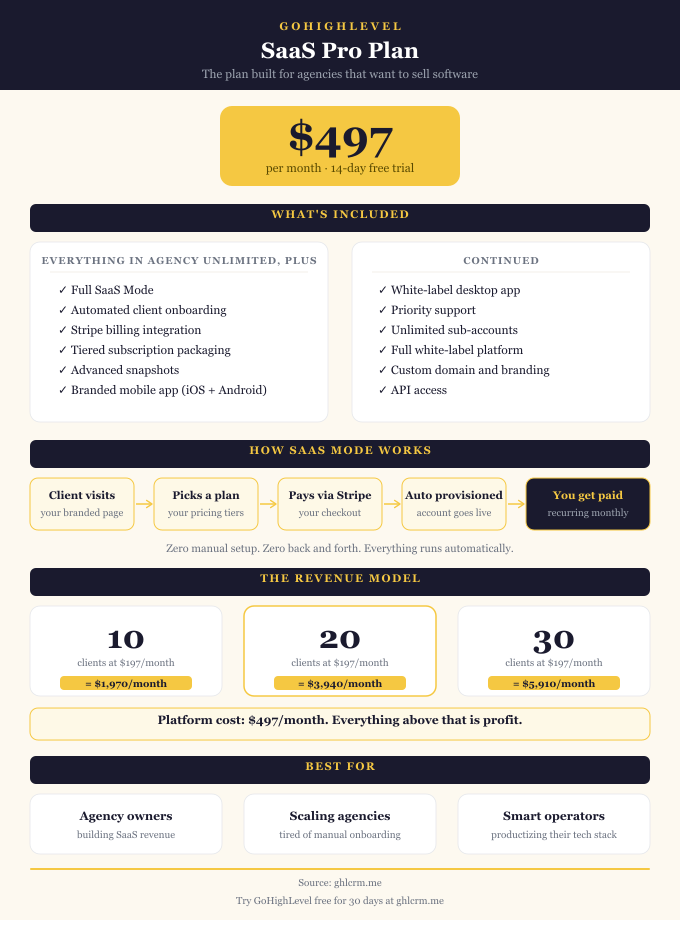
GoHighLevel Agency Pro or SaaS mode pricing plan is $497 per month (or $4,968 annually). This top-tier subscription gives you access to the platform’s most powerful feature, SaaS Mode, which lets agencies rebrand and resell GoHighLevel as their own proprietary software platform.
I will walk you through the value of the SaaS Pro plan, discuss the best-performing niches you can target with it, and show you how to get set up quickly and start generating recurring revenue streams.
GoHighLevel (GHL) Pro Plan: What Makes it Different?
GHL Pro is the official GoHighLevel pricing tier that transforms how agencies looking to transition to SaaS do business. Instead of simply using the platform to manage your clients’ marketing campaigns, you become a software company.
However, the agencies generating the most monthly recurring revenue from GoHighLevel SaaS are not just selling software. They’re combining it with a managed service.
This hybrid model commands significantly higher monthly fees, and churn drops because clients are tied to your results rather than just your software. When someone’s entire business runs through your software, they don’t cancel lightly.
Core Features Exclusive to GoHighLevel SaaS Pro Plan
In addition to the benefits of Agency Unlimited, the GoHighLevel Pro plan includes several features not available in lower-tier plans.
GoHighLevel SaaS Mode and Custom Pricing Configuration
The SaaS Configurator allows you to create up to 20 different pricing tiers for your clients. You might offer a Basic plan at $97, a Professional plan at $197, and a Premium plan at $397. Our SaaS pricing tool will help you determine a profitable pricing structure while staying competitive in your market.
Each tier can include different features. Maybe your Basic clients get access to the CRM and email marketing, while Premium clients get everything, including AI-powered chatbots and advanced workflow automations.
All pricing plans automatically integrate with your Stripe account. When a client signs up through your custom sales page, Stripe processes the payment and creates their sub-account. Customers also get features based on the plan they selected, and you send them their login credentials.
White-Label Mobile Application
The Unlimited plan gives you a branded desktop app, but the SaaS Pro plan takes it further with a fully white-labeled mobile application. Your clients download an app from the App Store or Google Play that shows your company name, logo, and colors. They never see the GoHighLevel name anywhere.
Your clients manage leads, respond to conversations, check reports, and update calendars from their phones, all within your branded ecosystem.
Advanced Rebilling Capabilities
The agency Pro plan enables markup rebilling across virtually every usage-based service. Phone calls, SMS messages, emails, AI Employee usage, domain purchases, WordPress hosting: you can add your own markup to every single one.
SMS segments cost approximately $0.0079, outbound calls cost $0.014 per minute, inbound calls run $0.0085 per minute, and email sending costs about $0.675 per thousand messages.
With rebilling enabled, you might charge clients two to ten times these amounts. A client sending 50,000 emails monthly costs you roughly $33.75, but you could charge them $100 or more, depending on your markup strategy.
The system is transparent and profitable. Clients can view their usage and charges in their dashboard, so they know exactly what they are paying for. They see exactly what they’re consuming. Meanwhile, you’re building predictable margins into every transaction.
Advanced API Access and Customization
While the Unlimited plan provides basic API access, the SaaS Pro plan opens up deeper integration possibilities. You can programmatically create sub-accounts, load snapshots, manage users, and control features at scale.
For agencies building custom solutions or integrating GoHighLevel into complex tech stacks, this expanded API access removes limitations.
Priority Support and SaaSpreneur Resources
When you’re charging clients for software subscriptions, you can’t afford downtime or slow support responses. The SaaS Pro plan includes priority support channels with faster response times.
You also get access to GoHighLevel’s SaaSpreneur program, which provides training, community support, and resources designed for agencies running SaaS businesses.
GoHighLevel Pro Plan Top-Performing Niches
Home Services (HVAC, Plumbing, Roofing, Pest Control)
In my opinion, this is the undisputed top niche for GHL-based SaaS right now. Home service businesses are simple to understand, easy to replicate across cities, and have one urgent problem: missed calls and lost leads.
The beauty of this niche is scalability. Once you build a working snapshot for a roofing company in one city, you can sell the same system to roofers in a hundred others.
Real Estate Agents & Mortgage Brokers
Real estate remains one of the most lucrative niches for GoHighLevel agencies. Agents are constantly chasing leads, and the difference between closing a deal and losing one often comes down to who follows up first.
A well-built GHL system automates that follow-up instantly, nurtures leads through a pipeline, and books calls without the agent lifting a finger. The added play here is the natural bridge to mortgage brokers. One client relationship can open the door to an entirely new vertical with minimal extra effort.
Med Spas, Chiropractors & Dental Practices
These are potential clients that are busy, underserved by generic software, and willing to pay for something that actually works.
Their biggest pain points are no-shows, missed follow-ups, and a lack of online reviews. GHL solves all three. Automated appointment reminders slash no-show rates.
Post-visit review request sequences build their Google presence on autopilot. And reactivation campaigns bring dormant patients back in without any ad spend. These clients also tend to stick around. Once the system is running, they never want to turn it off.
Law Firms & Attorneys
Law firms are an underrated goldmine. The market is enormous, with hundreds of thousands of solo practitioners and small firms across every region, yet relatively few GHL agencies are targeting them effectively.
The offer automates client intake, captures consultation requests around the clock, follows up with leads before competitors do, and builds the firm’s reputation through automated review collection. Personal injury, family law, and estate planning are the three most accessible sub-niches to start with.
Gyms, Yoga Studios & Fitness Coaches
Fitness businesses run on recurring revenue, which naturally aligns with a SaaS model. They already understand the concept of a monthly subscription, so the pitch is intuitive.
Go High Level can handle lead follow-up for trial offers, automate membership renewal reminders, re-engage members who’ve gone quiet, and run referral campaigns without any manual work. The lower price point per client is offset by the sheer volume of fitness businesses operating in every market.
Restaurants & Local Hospitality
Restaurants are responding particularly well to two specific GoHighLevel use cases right now: database reactivation and review automation.
A reactivation campaign, where you text a restaurant’s existing customer list with a compelling offer, is one of the fastest ways to generate visible ROI in the first week. Review automation then builds long-term credibility on Google and Yelp.
These quick wins make restaurants easier to close and retain, especially when the results are tangible and immediate.
The GoHighLevel SaaS Pro Setup Process
Step 1: Get on the Right Plan
GoHighLevel SaaS Pro is the plan to be on if you’re building a SaaS business. It unlocks SaaS mode, which automates client billing and subscription management through Stripe, gives you unlimited sub-accounts, and includes the white-label mobile app. Everything below assumes you’re on this plan.
Step 2: White-Label the Platform
Log into your agency settings. Replace every GoHighLevel reference with your own brand. Upload your logo, set your brand colors, and configure a custom domain so clients log in through your URL.
Customizing the HighLevel platform with your branding makes it feel like your own software product rather than a resold platform.
If you want the white-label mobile app, you’ll need an Apple Developer account and a Google Play account. Submit your app through GHL’s white-label app process and expect a two- to four-week turnaround before it goes live on both stores.
Step 3: Configure SaaS Mode
Inside your agency dashboard, open the SaaS configurator and build your pricing tiers. Most operators run two or three plans, such as a starter, growth, and pro, each with a clear difference in features or usage limits.
Connect Stripe during this step, and GoHighLevel handles all client billing automatically from there, including renewals, failed payments, and cancellations.
Step 4: Build Your Niche Snapshot
A snapshot is a pre-built sub-account containing everything a client needs from day one: funnels, pipelines, automations, email and SMS sequences, calendars, and forms.
Build yours around your specific niche so every element matches how that type of business operates.
A strong snapshot means clients are up and running within a day or two of signing up and need minimal hand-holding.
Step 5: Onboard Clients Into Sub-Accounts
Each client gets their own sub-account. When someone signs up, create their sub-account, load your snapshot, and enter the business name, logo, and contact details.
Then connect their communication channels, which include their SMS number, email, Google Business Profile, and calendar.
SaaS mode controls which features each client can access based on their plan tier, so this step is largely systematic once your snapshot and tier structure are in place.
Step 6: Activate Core Automations
The automations are what justify the monthly fee. Before onboarding your first client, build and test these inside your snapshot: an instant lead follow-up sequence, appointment reminders via SMS and email, a no-show follow-up, a post-service review request, and a reactivation campaign for cold contacts.
If response speed is a pain point for your niche, configure GHL’s AI conversation feature. Train it on the client’s services, FAQs, and pricing so it handles inbound inquiries automatically, then passes qualified leads to a human.
Step 7: Build Your Own Funnel and Onboarding Flow
You need a front-end offer that sells the platform and your offer, and a back-end that onboards clients without requiring your time. Build a focused niche funnel with a clear, problem-focused headline, a brief explanation of what the platform does, and a calendar booking as the call to action.
Once someone becomes a client, an automated onboarding sequence should take over: a welcome email, a self-serve setup portal, a video walkthrough, and a simple checklist of what they need to provide.
Step 8: Automate Monthly Reporting
Set up automated monthly reports so every client receives a summary of what the platform delivered that month. Include leads captured, appointments booked, reviews generated, and messages sent.
This keeps the value visible, reduces cancellations, and naturally opens the door to upsell conversations without you having to initiate them.
Step 9: Launch
Launch your marketing campaign. The first few accounts will reveal gaps in your snapshot, onboarding friction, and features that need work. Iterate fast based on real usage, not assumptions.
As the system tightens, onboarding gets faster, retention improves, and recurring revenue compounds. That is the point of building on the SaaS Pro plan in the first place.
Comparing SaaS Pro with Agency Unlimited
Understanding the difference between these two plans clarifies whether the extra $200 monthly investment makes sense for your situation.
The Agency Unlimited plan costs $297 per month and delivers powerful capabilities. You get unlimited sub-accounts, meaning you can manage as many clients as you want from a single dashboard. The white-label desktop app lets you brand the interface with your domain and logo. You have access to all of
GoHighLevel’s core marketing tools include CRM, funnel builder, email and SMS marketing, website builder, pipeline management, workflow automation, and calendar scheduling.
For agencies that use GoHighLevel to deliver better services, the Unlimited plan is often enough. You build funnels for clients, set up their automation sequences, manage their leads, and charge professional service fees for your work.
The platform helps you work more efficiently and serve more clients, but your revenue model centers on providing marketing services rather than selling software.
The GoHighLevel SaaS plan changes that equation. You keep everything from the Unlimited plan, but add the ability to package HighLevel as your own product.
Clients don’t hire you to build their funnels; they subscribe to your software platform and build their own funnels using the tools you provide. You shift from being a service provider to being a software company that may also offer services.
This distinction matters for revenue stability. Service-based revenue fluctuates with client retention and project flow. Software revenue compounds.
Each new client adds predictable monthly recurring revenue that continues as long as they remain subscribed. When you reach 50 clients paying $197 monthly for your branded CRM platform, that’s nearly $10,000 in monthly recurring revenue before you count any service fees.
The Unlimited plan doesn’t include automated client billing within the platform, which means you handle invoicing separately through your own systems. With SaaS Pro, Stripe integration manages everything automatically: subscription billing, usage charges, failed payments, upgrades, and cancellations.
The Unlimited plan also lacks the mobile app white-labeling and the advanced rebilling controls that let you profit from usage-based services. If your clients use phone systems, send lots of texts, or rely heavily on email campaigns, those rebilling markups can add significant revenue on the SaaS Pro plan.
The Real Investment Analysis
The $497 monthly price is quite significant when compared to the $297 Unlimited plan. But let’s examine the actual return potential.
If you’re reselling GoHighLevel as your own SaaS product at $197 per client, you need approximately three paying clients to cover your platform costs.
Your fourth client puts you in profit relative to the platform expense, and every client beyond that is pure upside (minus your costs for support, usage fees, and operations).
Compare this to traditional agency service models where you might charge $2,000 monthly retainers but spend dozens of hours delivering campaigns, creating content, analyzing data, and attending client meetings. With a SaaS model, your time investment per client drops dramatically after the initial onboarding.
Usage-Based Costs and Margin Management
Don’t overlook the additional costs beyond the base subscription. Every SMS message, phone call, email sent, and AI conversation generates usage charges that GoHighLevel passes through to your agency account. These costs are pay-as-you-go and vary based on how actively your clients use the platform.
The good news is that rebilling transforms these costs from a financial burden into a profit center. When properly configured, your markups on usage-based services can generate substantial additional revenue.
A client making 1,000 minutes of outbound calls monthly costs you roughly $14. With a 3x markup, you charge them $42 and pocket $28 in profit from that single usage category.
You also need to factor in A2P 10DLC registration costs if your clients are texting US numbers for business purposes. This includes one-time registration fees, ongoing campaign fees, and small per-message carrier surcharges.
Exact amounts vary by carrier and message volume, but you should build these costs into your client pricing from the start.
WordPress hosting (if you enable it for clients) costs around $10 per site per month at the standard tier.
AI Employee usage, if you offer it, runs about $97/month in unlimited mode or can be billed per interaction. The white-label mobile app includes setup costs and quarterly hosting fees that you need to incorporate into your pricing strategy.
None of these costs are hidden (GoHighLevel documents them clearly), but they do require careful planning. Successful SaaS agencies build comprehensive pricing calculators that account for typical usage patterns, apply appropriate markups, and remain competitive in their target markets.
GoHighLevel Agency Pro: The Path Forward
The GoHighLevel Agency Pro plan at $497 per month gives you the leverage to generate high recurring monthly revenue by offering your services and software subscriptions. It’s an investment in transforming your business model. For agencies ready to make that transition, the revenue potential significantly outweighs the cost.
Calculate your breakeven point using realistic client-acquisition assumptions. If you need three paying clients to cover platform costs and believe you can sign up one new client monthly through focused marketing efforts, you’ll be profitable within your first quarter.
Scale those numbers based on your actual capabilities and growth goals. Remember that the Unlimited plan remains a strong option if you’re not ready for a full SaaS commitment.
You can always upgrade to this HighLevel CRM pricing plan later, once your client base and operational maturity make the investment more clearly justified. GoHighLevel makes the transition seamless, and all your existing sub-accounts migrate with you.